

How to Choose a LiFePO4 Battery Supplier for Your Energy Storage Business
The gaps that trip most buyers up
Back in 2014, I was sent to a solar exhibition in Thailand to meet potential customers. I was young, and the solar PV market was booming — much like the weather there, very hot. Everyone I met was talking about it, and about how lucrative it was. Back then, most people interested in solar PV didn’t have much technical knowledge. Understanding a solar inverter, let alone an entire system, was rare. It took real time — first book knowledge, then field knowledge — before they could make a final decision with any confidence.

As more Chinese solar panel manufacturers flocked in, offering highly identical products with brands and credibility not yet established, it became another steep learning curve — figuring out which suppliers or partners were the right ones to ride with, especially for small distributors and installers.
Over the years, I’ve lost count of how many times someone in Thailand has asked me, “Is this PV company credible?” or “What do you think of this supplier?” Even today, with AI that seems to know everything, there’s still a gap between what’s online and what’s real on the ground.
That’s the gap I want to name upfront: the knowledge gap, the technical know-how gap, and the “what does this actually look like in reality” gap — all standing between smaller distributors and installers, and the small/mid-sized manufacturers they’re trying to evaluate. Internet access is in everyone’s pocket now, exhibitions happen every year, and none of it solves the problem. If anything, you drown in it — endless identical product listings, endless claims, no way to tell them apart from a screen.
This guide won’t close that gap entirely. But it will give you enough of a lens to ask the right questions, spot the right red flags, and pick a LiFePO4 battery supplier who’s actually built to be a long-term partner — not just a good quote at an exhibition booth.
What characteristics a good manufacturer stands for

Real factory. This is the foundation everything else sits on. A company that owns and operates real production — not a trading company reselling someone else’s cells under their own label — has skin in the game on quality, consistency, and long-term support. It doesn’t mean trading companies are automatically untrustworthy, but you need to know which one you’re actually dealing with, because the accountability is different.
Product line-up. A supplier with a narrow, one-size-fits-all line-up is telling you they haven’t had to solve for different customer needs yet. A broader line-up — different capacities, form factors, voltage configurations — usually signals more engineering maturity and more room to grow with them as your own product range expands.
Human touch. This one is underrated. Can you get a straight answer from a real person when something doesn’t go to plan? Suppliers who are responsive, transparent, and willing to have a hard conversation when there’s a problem are the ones you want to be tied to for the next five years — not the ones who are easiest to deal with when everything’s going well.
Supply stability. Cell shortages, price swings, and lead time chaos aren’t hypothetical — they’ve happened industry-wide more than once in the last few years. A supplier’s ability to weather that, and keep your orders moving through it, matters more than almost anything else once you’re relying on them for repeat business.
OEM/ODM capability. If your business depends on any level of customization — branding, enclosure design, wiring harnesses, BMS features — this is non-negotiable. A supplier that can only offer their standard catalog product is a supplier you’ll eventually outgrow.
Of course, there are other factors worth weighing too — certificates, warranty terms, after-sales service, current sales network coverage, system integration capability. Which of these matter most will depend on your own market position — but all of them share the same problem: they’re easy to claim and hard to verify from a datasheet or a booth conversation. That’s exactly where the next section comes in.
How to verify supplier claims
As a small/mid-sized manufacturer myself, I’ll be upfront about where I sit in this conversation.
I used to work in a big corporation, and people gravitate toward big corporations for good reason — brand, trust, quality, and after-sales guarantees that feel safe. Small and mid-sized suppliers, by contrast, struggle precisely because they lack that built-in brand and trust, which are often the most critical factors in a B2B deal. It takes real effort to prove you’re legitimate, operational, certified, and actually capable of delivering — effort a big name doesn’t have to spend.
Here’s how to cut through that, on either side of the table:
Real factory. Start here, and don’t skip it. A live video call walking the production floor tells you more in ten minutes than any brochure. Ask to see the winding or stacking line, the formation room, the PACK assembly area. If a “manufacturer” keeps redirecting you to photos instead of live video, that’s your answer. I’ve had clients ask for a live walk-through with zero notice — not out of distrust, but because that’s exactly the kind of scrutiny a good supplier should welcome, not dodge.
Product certificates. Don’t assume there’s one universal checklist here — the right certification depends on where you’re selling, not on which one sounds the most impressive. UN38.3 for transport is close to non-negotiable everywhere. Beyond that, a supplier targeting the EU or North America needs CE, UL, or IEC62619; a supplier serving markets where CCC (China Compulsory Certificate, often called “3C”) is the accepted standard doesn’t need to chase a Western certification just to look more credible — that’s paying for a badge your buyers were never going to check. What matters is that whatever certificate they hold is real. Don’t accept a PDF at face value — certificates get shared, reused, sometimes borrowed from a sister company that isn’t actually who you’re buying from. Cross-check the certificate number against the issuing body’s database, and confirm the entity name on the certificate matches your contract. Five extra minutes, and it’s saved my clients more than once.
Real-world cases and projects. Anyone can put a logo wall on a website. Ask for something harder to fake — a site reference you can actually contact, install photos with timestamps, a project that’s been running long enough that you can ask “how has it held up?” A supplier with nothing to show after years in business is telling you something, even if they don’t say it out loud.
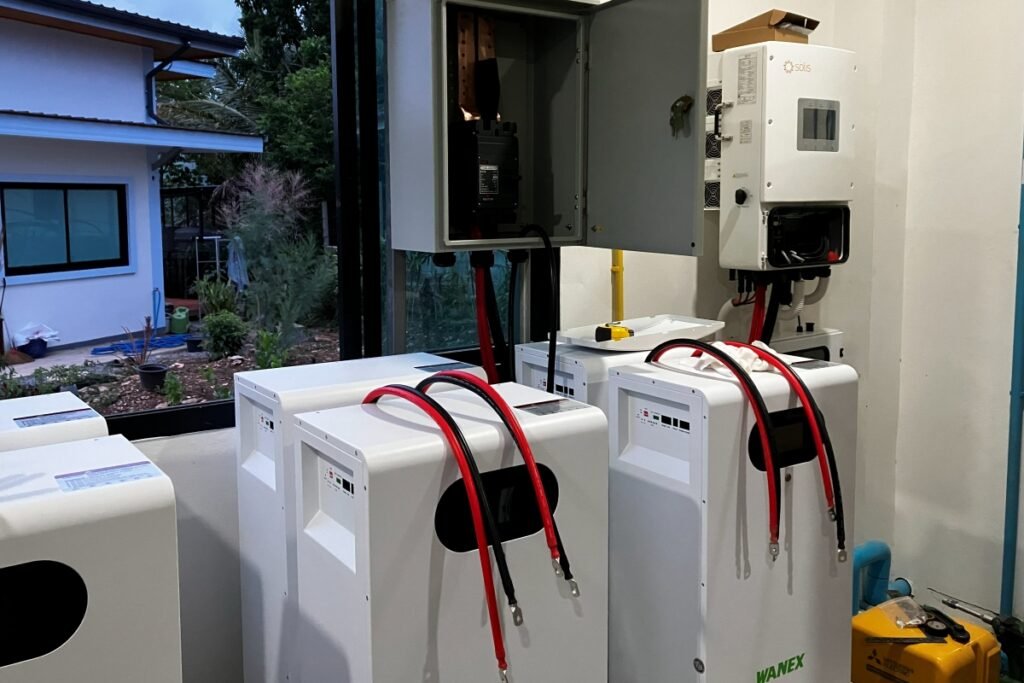
On the other hand, small and mid-sized suppliers offer something the big names often can’t: flexible MOQ, real OEM/ODM engineering, sharper pricing, and terms that flex with your business instead of the other way around. That might be exactly the right partner for you. As the old Chinese saying goes, 门当户对 — marrying someone of equal standing — finding a partner whose scale actually matches yours matters, because that’s how both sides end up growing together instead of one side always being an afterthought.
I felt this firsthand with one of our U.S. clients — we’ve been supplying their battery cabinets for over four years now. Why us, and not one of the giants? Because their order volume didn’t move the needle for the big manufacturers, and their wiring harness needed to be custom to their enclosure design. We could say yes to both. A bigger supplier would have said no to the first and quoted six months for the second.
Commercial factors to negotiate
Once you’ve confirmed a supplier is real and capable, the conversation shifts to whether the deal actually works for your business. This is where a lot of buyers under-negotiate, simply because they don’t know what’s normal.
MOQ isn’t as fixed as it’s often presented. It’s usually a function of cell batch size, BOM complexity, and how custom your configuration is — ask what MOQ looks like at a few different customization levels before assuming the first number quoted is final.
Pricing tiers should scale with volume, but also ask what’s driving the price — cell grade, BMS features, enclosure materials, certification costs baked in. Two quotes with the same number per kWh can represent very different products underneath.
Payment terms are where trust gets tested in both directions. A supplier unwilling to discuss anything beyond 100% upfront, even after a track record is established, is worth a second look — and so is a buyer expecting open terms on order one.
Lead time quotes are often optimistic by default. Ask what the lead time actually was on their last three shipments, not just the standard quote, and ask what happens to that timeline if there’s a customization change mid-production.
Closing checklist: how to shortlist
Before you commit, run every supplier you’re seriously considering through this:
- Have you seen a live video walk-through of the factory floor, not just photos?
- Have you verified their certificates directly with the issuing body?
- Can they give you a reference site or project you can independently confirm?
- Does their scale actually match your order size — are you a priority account or an afterthought?
- Have you gotten a real lead time based on recent shipments, not the standard quote?
- Do their payment terms and MOQ work for where your business is today, not where you hope it’ll be in two years?
Get three suppliers through this checklist side by side. The gaps that show up — in response time, in willingness to show you the real factory, in how they handle a tough question — usually tell you more than the spec sheet ever will.