
Is A Home Battery Worth It? What the Real Numbers Look Like in Thailand
Most home battery ROI calculators share the same weakness: they’re built on catalog prices and textbook assumptions, not on what a homeowner actually pays a contractor to show up, wire a system together, and switch it on. The gap between the two can be large enough to change the entire investment case. This piece works through that gap using real installed costs from Thailand, and a real household — one where the numbers weren’t estimated, but billed.
Why the Standard Cost Model Falls Short
A common way to illustrate battery ROI is to price a 10 kWh battery on its own, at roughly $0.25 per watt-hour, and call that the upfront cost. It’s a clean number, and it’s also incomplete. No homeowner installs a battery by itself. It arrives bundled with solar panels, a hybrid inverter capable of managing both grid and battery flows, mounting and wiring accessories, and the labor to put it all together and commission it.
Battery hardware has also moved a long way from that $0.25/Wh reference point. In Southeast Asia, a 16 kWh residential battery unit now typically sells for around $1,500–1,600 — closer to $0.09–0.10 per watt-hour. Pricing a system without accounting for that shift overstates the cost of the battery and understates everything else that has to go around it.
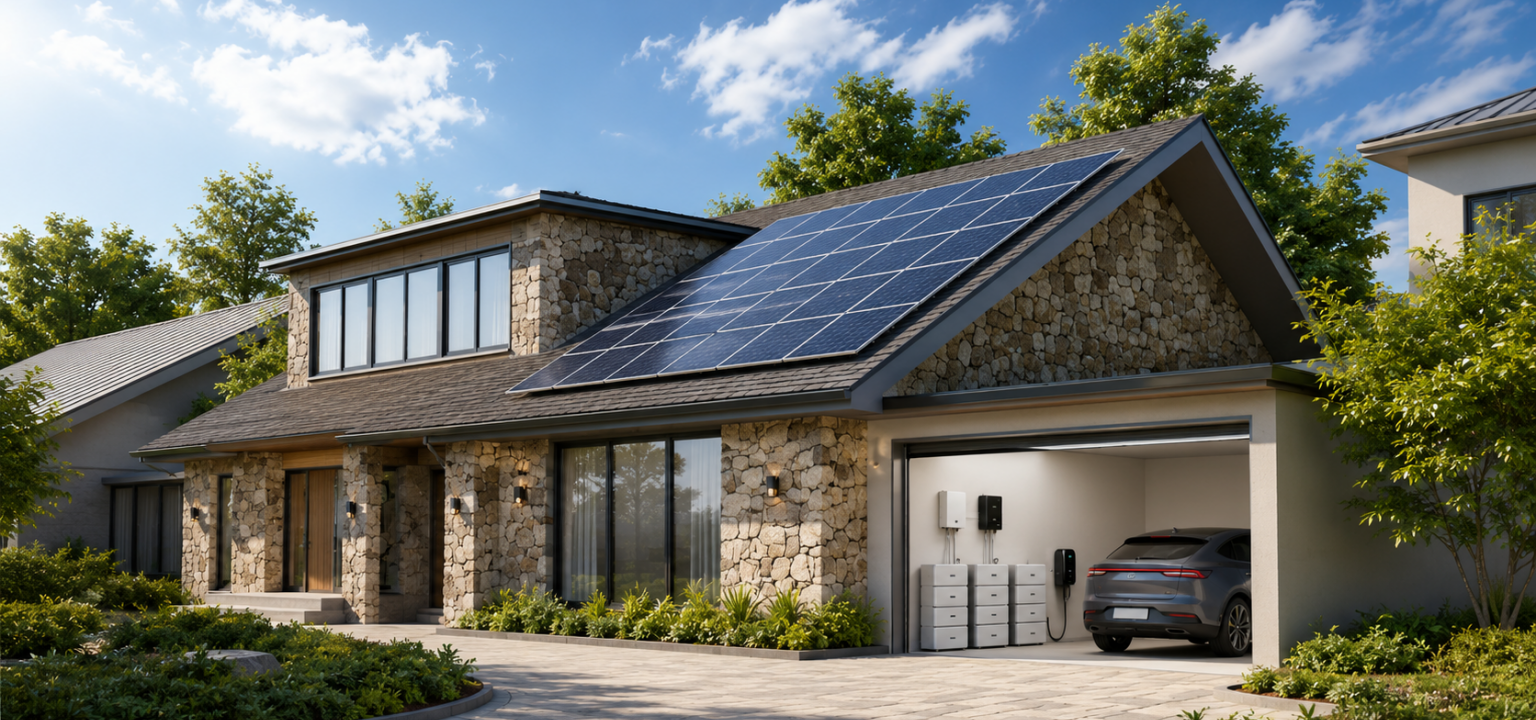
A more realistic system for a Thai household — 12 kW of solar, an 8 kW hybrid inverter, and 32 kWh of battery storage — breaks down closer to this:
| Component | Cost (USD) |
| Solar panels | ~$1,600 |
| Hybrid inverter | ~$1,500 |
| Batteries | ~$3,000–3,200 |
| Accessories (combiner box, wiring, etc.) | ~$300 |
| Labor (Thailand) | ~$500 |
| Total | ~$6,900–7,100 |
In Thai baht, that’s roughly 230,000–250,000 THB installed. It’s a materially different starting point than a bare battery-only estimate, and it’s the number that actually determines payback period.
A System That Grew Alongside a Household’s EV Adoption

More families are adding an EV to the driveway, and Southeast Asia is no exception. As that shift plays out, a pattern is emerging as best practice: pairing solar generation with battery storage to charge the car at home, rather than relying on the grid or public charging. It’s the combination that maximizes ROI, and the clearest way to see why is through a system that wasn’t built as a theoretical exercise but expanded to solve an actual problem.
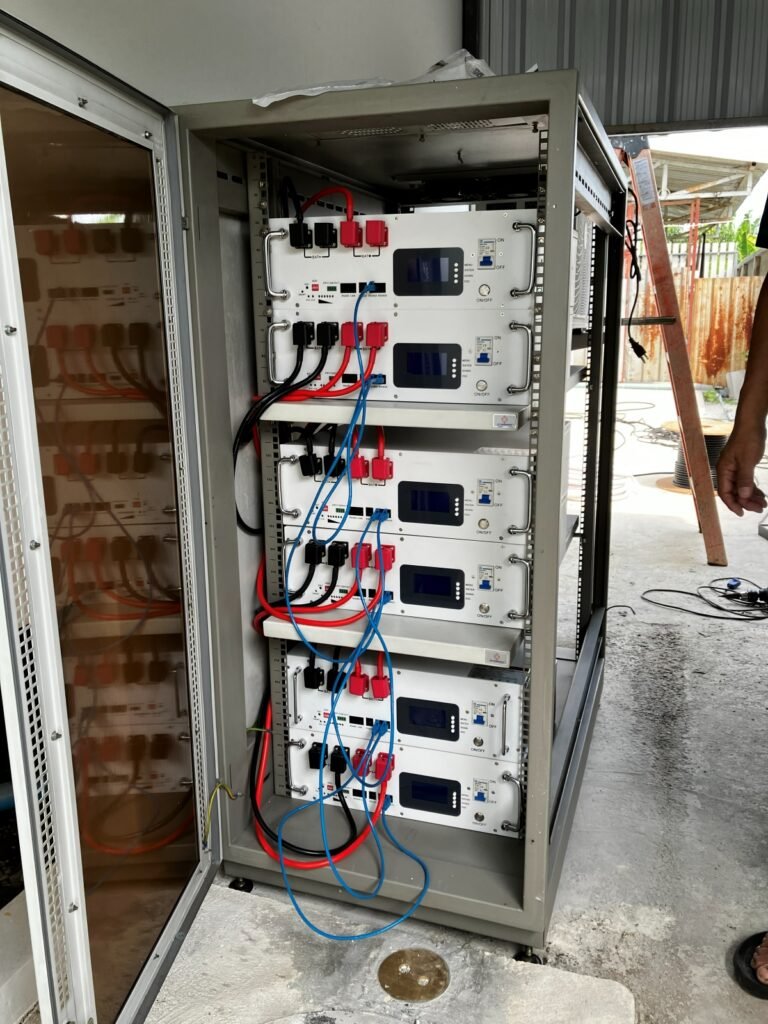
The household had run a 5 kW on-grid solar setup for years — unremarkable, doing what on-grid systems do, feeding surplus power back to the utility. That worked fine until an EV joined the household. A new no-export rule meant the old system could no longer offload its excess generation to the grid, which took away the main advantage of going solar in the first place. Rather than shrink their ambitions, the household scaled up: the array grew to 10 kW, the inverter was swapped for an 8 kW hybrid unit capable of managing battery flow, and a 30 kWh battery bank was added. Instead of surplus power going nowhere, it now goes into the house and into the car.
The cost is known with unusual precision here, because it was priced and installed directly rather than estimated after the fact: the full expansion — panels, hybrid inverter, battery bank, labor, everything — ran 180,000–200,000 Baht.
Where the Savings Actually Come From

The system is expected to generate about 14,600 kWh a year. Roughly 40% of that goes to the household, and 60% goes to EV charging — a split shaped by the fact that EV charging is a much larger, more concentrated load than typical household consumption. Applying an 85% round-trip efficiency to account for battery losses, the savings work out to two distinct streams:
- Household electricity savings, measured against the residential grid rate of about 4 Baht/unit, come to roughly 19,800 Baht a year.
- EV charging savings are measured differently, and this is where the bulk of the value shows up. The relevant comparison isn’t the grid rate — it’s what the owner would otherwise pay at a public DC fast charger, which in Thailand runs 6–10 Baht/unit depending on time and location. Using 8 Baht as a fair midpoint, EV charging savings come to roughly 59,600 Baht a year.
Together, that’s about 79,400 Baht a year in avoided spending — and against an installed cost of 180,000–200,000 Baht, it puts payback at roughly 2.3 to 2.5 years.
Note: the 85% round-trip efficiency is applied uniformly across both shares as a simplifying assumption. Strictly, that loss only applies to energy that’s actually cycled through the battery — solar consumed in real time as it’s generated doesn’t take the same hit. Treating it as a flat factor makes the estimate slightly conservative rather than exact, but keeps the calculation straightforward.
That EV charging comparison is worth sitting with. It’s the single biggest reason this system outperforms a typical arbitrage-only battery: the “avoided cost” being displaced isn’t a cheap off-peak grid rate, it’s the premium price of public fast charging. A battery-and-solar system that charges an EV at home is competing with 6–10 Baht/unit, not 4 Baht/unit — and that difference roughly triples the value of every kWh it handles.
What This Means for the General ROI Picture
The standard degradation and efficiency factors from any textbook model still apply here and shouldn’t be ignored:
- Lithium-ion batteries typically lose 1.5–3% of capacity annually, so a system’s output in year eight looks meaningfully different from year one.
- Round-trip efficiency in the 85–90% range is a reasonable planning assumption, and it’s already baked into the savings figures above.
- Warranty terms commonly guarantee 70–80% state-of-health after 5–10 years, assuming roughly one cycle per day at 25°C — deviate from that (more cycles, hotter operating conditions) and real-world lifespan will differ from the warranty baseline.
What changes the conclusion isn’t the physics of the battery — it’s the completeness of the cost input and the value of what the stored energy displaces. A bare-battery cost estimate paired with a simple off-peak/peak arbitrage spread will always look like a marginal, multi-year payback investment. A fully-installed system cost paired with EV charging as the primary offset — where the alternative is expensive public fast-charging, not cheap grid power — tells a very different story, and one that’s closer to what homeowners are actually experiencing.
The Practical Takeaway
If you’re sizing up a battery system, two adjustments matter more than any efficiency curve or degradation assumption:
- Price the whole system, not just the battery. Panels, hybrid inverter, accessories, and labor are not rounding errors — in the example above, the battery itself was under half the total installed cost.
- Know what you’re actually displacing. Savings against a flat residential rate are the floor, not the ceiling. If any part of that stored energy is offsetting an expensive alternative — public EV fast-charging being the clearest example — the real payback period can be several times faster than a grid-rate-only calculation suggests.
Battery prices are still falling, and system costs will keep coming down with them. But even at today’s prices, sized and priced correctly, and matched to the right use case, a home battery system can pay for itself in well under three years — not the five-to-seven-year timelines that bare-hardware estimates tend to produce.