
LiFePO4 Battery Cost China: How Much Do They Really Cost in 2026?
1. What a Bangkok Showroom Taught Me About Battery Pricing
LiFePO4 battery cost China figures are almost always quoted as EXW — the factory-gate price before freight, duties, or local charges are added. That distinction became very real to me on a recent trip.
I travel to Bangkok often, and to other Thai cities for site visits, and I’ve noticed more and more Chinese EVs on the road there. As a LiFePO4 battery manufacturer, that made me genuinely curious: how much does one of these vehicles actually cost once it lands in Thailand?

Last month, a client and I walked past a shopping mall showcasing several EV models with price tags attached. One was marked at just over 1 million baht; another at 950,000 baht. Both numbers were far higher than what the same models sell for back in China.
Batteries — the core component in both EVs and energy storage systems — follow the same pattern. The final price is considerably, but reasonably, higher than the ex-factory (EXW) price, because freight, insurance, import duties and taxes, and local charges all stack on top before a battery reaches a shelf or showroom.
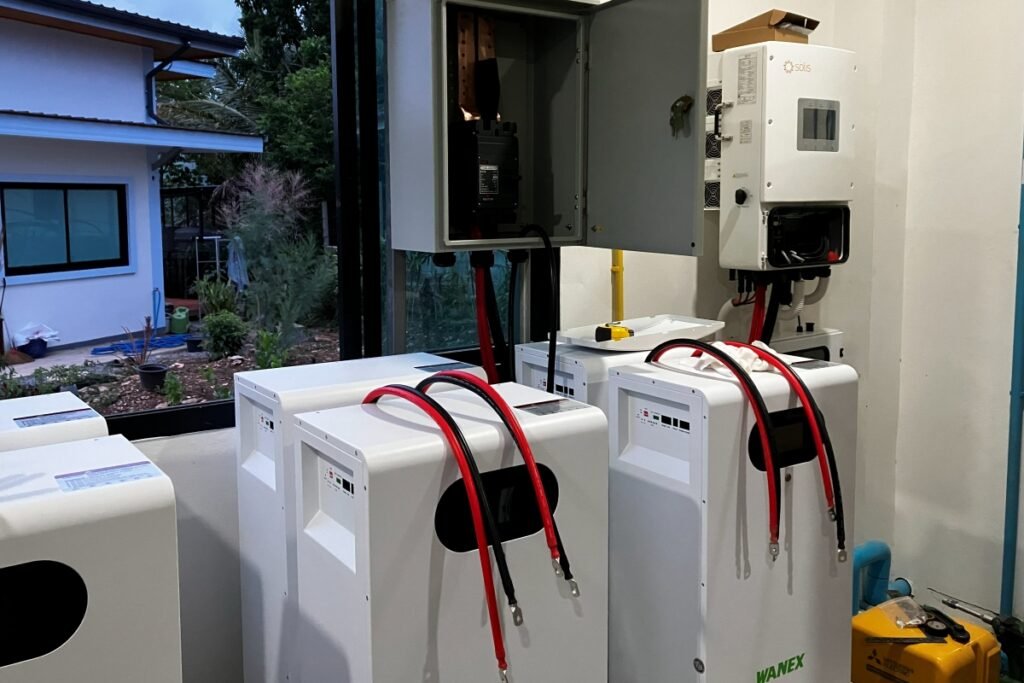
Even when products are shipped to Southeast Asia by truck as “general cargo” to minimize duties, the underlying China-side costs — freight, insurance, and local handling — don’t disappear. They still have to be added to arrive at a true landed cost.
This guide walks through where that gap actually comes from, so distributors and installers can build accurate landed costs into their quotes — and so anyone standing in front of a price tag in Bangkok understands why it doesn’t match what they saw online.
2. How Much Do LiFePO4 Batteries Cost in China?
Regardless of make, battery cells typically account for roughly 55–65% of a battery product’s total EXW cost. As of mid-2026, with raw material prices trending upward, LiFePO4 cell prices sit somewhere between CNY 0.35–0.38 per watt-hour.

Using the mid-range of that cost-share assumption as a guideline, a typical residential battery product — regardless of its specific configuration, design, or energy capacity — works out to roughly $87–94 per kilowatt-hour on an EXW basis.
That said, this is a guideline, not a quote. Several factors move the number in either direction:
- Cell chemistry and cell-maker tier (first-tier vs. second-tier cell suppliers)
- BMS complexity (basic vs. smart BMS with communication protocols)
- Enclosure material and IP rating
- Wiring harness and connector specification
- Production scale and degree of customization
Note: The 55–65% cost-share figure is an industry approximation. If you’re publishing a specific number publicly, it’s worth confirming your exact cell-cost share and CNY/USD conversion rate so the $87–94/kWh figure holds up to scrutiny from technical buyers.
3. Shipping LiFePO4 Batteries from China: Why It Costs More
Batteries are heavy — far heavier than general goods of similar size. A standard 16kWh residential battery weighs around 120kg. Combined with the fact that lithium batteries are classified as Dangerous Goods (DG) due to their chemistry, this makes them regulated cargo.

That classification triggers a set of procedures required industry-wide to ensure safe transport:
- Controlling the state of charge (SOC) at the time of ex-factory shipment (typically capped around 30% for transport)
- Accurate DG declaration and UN classification (UN3480 for lithium-ion, UN3536 for large format cells/batteries in some cases)
- Compliant packaging, marking, and labeling
- Specialized handling and storage at every point in the supply chain — from the factory warehouse to the ocean carrier to the destination port
These requirements add real cost: DG-certified freight forwarders charge a premium, ocean carriers apply DG surcharges, and not every port or trucking company is equipped to handle the cargo. This is the single biggest reason battery freight costs more per kilogram than shipping general electronics or hardware.
4. How Order Quantity Changes Your Cost

Order quantity matters — but probably less than most first-time buyers expect. For standard residential products, the underlying EXW price is largely fixed regardless of configuration, and the price gap between small, medium, and large order quantities is generally under 3%.
Where quantity matters more is on the logistics side. Smaller orders shipped via LCL (less than container load) or express courier carry proportionally higher per-unit freight, insurance, and handling costs than a full container load (FCL). So while the factory price barely moves with volume, your landed cost per unit can shift meaningfully once shipping is factored in — which is exactly why MOQ conversations with a supplier should always include a freight discussion, not just a unit-price discussion.
5. Putting It Together: A Worked Landed-Cost Example
Freight and order quantity are only two pieces of the puzzle. Layer in insurance, import duties, local taxes, and handling charges, and the real gap between EXW and landed price starts to take shape. Let’s return to the Bangkok example from the introduction. Say a distributor is importing a 16kWh residential LiFePO4 battery at an EXW price of roughly $1,450 (using the $87–94/kWh range above).
| Cost Component | Illustrative Add-On | Running Total |
| EXW Price (16kWh) | — | $1,450 |
| International Freight (DG surcharge included) | ~8–12% | $1,566–1,624 |
| Cargo Insurance | ~0.5% | $1,573–1,632 |
| Import Duty | Varies by HS code / country (often 0–10%) | Varies |
| Local VAT/GST | Varies by country (e.g., 7% in Thailand) | Varies |
| Port, Customs & Inland Logistics | ~3–6% | Varies |
Figures above are illustrative only — actual freight, duty, and tax rates depend on your shipping route, destination country’s tariff schedule, and HS code classification. Always confirm current rates with your freight forwarder and customs broker before quoting a landed price.
Even on the conservative end, it’s easy to see how an EXW price under $1,500 can land closer to $1,900–2,100 by the time duties, taxes, and local charges are added — and that’s before a distributor’s own margin. This is exactly the gap that shows up on the showroom floor in Bangkok, Jakarta, or anywhere else batteries and EVs are imported.
6. FAQ
How much does a LiFePO4 battery cost from China? As of mid-2026, EXW prices for residential LiFePO4 battery products run roughly $87–94 per kWh, though the exact figure depends on cell tier, BMS specification, and enclosure design.
Is it cheaper to import LiFePO4 batteries directly from China? In most cases, yes — buying directly from a Chinese manufacturer avoids the markups added by intermediaries and local distributors. However, buyers still need to account for freight, duties, taxes, and compliance costs to get a true landed-cost comparison.
How much does it cost to ship lithium batteries from China? Shipping costs vary by route, volume, and carrier, but lithium batteries carry a dangerous goods (DG) surcharge on top of standard freight due to their UN classification and required handling procedures. Expect this to add roughly 8–12% or more to the EXW cost, depending on shipment size and route.
Can LiFePO4 batteries be shipped by sea? Yes. Sea freight is the standard method for most commercial-volume LiFePO4 battery shipments, provided the batteries are shipped at the required state of charge, properly classified, packaged, and labeled as dangerous goods.
What documents are required to import LiFePO4 batteries? Typical documents include a UN38.3 test summary, MSDS (Material Safety Data Sheet), commercial invoice, packing list, bill of lading, and any destination-market certifications (such as CE or local compliance marks) required for sale.
What is the difference between EXW, FOB, CIF and DDP? These are Incoterms that define who’s responsible for cost and risk at each stage of shipping. EXW means the buyer takes over at the factory door; FOB means the seller covers cost until the goods are loaded on the vessel; CIF adds freight and insurance to the destination port; and DDP means the seller delivers with all duties and taxes paid, handing over a fully landed product.
Do LiFePO4 batteries have import duties? It depends on the destination country and the HS code the product is classified under. Some countries apply reduced or zero duty on battery cells and finished battery products to encourage clean-energy adoption, while others apply standard rates. Always check with a licensed customs broker in the destination country.
What is the MOQ for importing batteries from China? MOQs vary by manufacturer and product line, but for standard residential battery products, the EXW price difference between small and large orders is typically under 3%. The bigger consideration at low order volumes is the higher per-unit freight and handling cost from shipping less than a full container.
7. Get an Accurate Landed Cost for Your Market
Every destination country has its own duty structure, certification requirements, and freight dynamics — which means the only way to get a landed cost you can actually quote to customers is to work through it with your supplier and freight forwarder together.
If you’re a distributor or installer evaluating LiFePO4 battery suppliers, reach out for an EXW quote alongside a freight and compliance estimate for your specific market — that’s the number that actually matters for your bottom line.