
8 LiFePO4 Battery Specifications That Are Easy to Misunderstand
Most LiFePO4 battery specifications on spec sheets look straightforward — voltage, capacity, cycle life, dimensions. But several of the numbers on that sheet mean something more specific than they first appear, and misreading them is one of the most common ways buyers end up with a battery that technically matches the spec sheet and still underperforms in the field. The eight specifications below are the ones most worth a second, more careful look.
1. Nominal Voltage — and Why the Cut-Off Voltage Matters
A “51.2V battery” doesn’t operate at 51.2V all the time. Nominal voltage is a reference point, not a constant — the actual voltage moves across a range as the battery charges and discharges, bounded by the charging voltage at the top and the discharge cut-off voltage at the bottom.

Take a typical 16S LFP battery as an example:
- Nominal voltage: 51.2V
- Maximum charging voltage: typically around 58.4V
- Discharge cut-off voltage: depending on BMS/system design, often around 44.8V
That’s a real operating window of roughly 44.8V to 58.4V — nominal voltage sits somewhere in the middle of that range, not at either end.
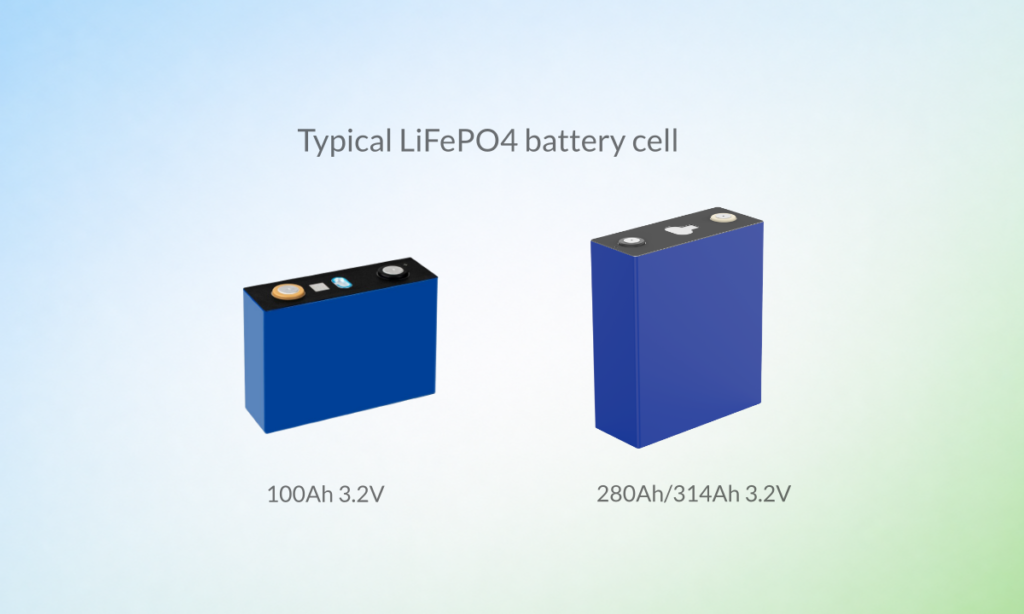
The cell-level numbers explain where those pack-level figures come from. Most 280Ah and 314Ah cell specifications list a working voltage range between 2.5V and 3.65V, with a discharge cut-off of 2.5V when the temperature is above 0°C, and 2.0V below 0°C — meaning a typical 314Ah cell can still deliver power at a lower voltage when it’s cold.
Here’s the part that’s easy to miss: the cell’s cut-off voltage is a physical limit, while the pack’s cut-off voltage is a design choice. Sixteen cells in series at 2.5V each add up to 16 × 2.5V = 40V, so on paper the pack could keep discharging all the way down to 40V. But in this example the BMS is set to cut off at 44.8V, which works out to 44.8 ÷ 16 = 2.8V per cell — deliberately higher than the cell’s own 2.5V limit. That gap is a safety margin, and it exists for practical reasons: cells in a pack are never perfectly identical, so the weakest cell reaches its limit first, and stopping earlier keeps every cell further away from the over-discharge zone. In an LFP cell, the voltage also drops steeply near the end of discharge, so there is usually only a small amount of energy left between 2.8V and 2.5V — the margin costs little usable capacity, while protecting the cells noticeably.
Why the usable voltage window matters:
- If the charge voltage is set too high, cells can be pushed into overcharge stress even if the BMS eventually cuts off — accelerating degradation over time rather than causing an immediate failure.
- If the discharge cut-off is set too low, cells can be driven into over-discharge, which is one of the more damaging conditions for LFP chemistry and can cause permanent capacity loss.
- Different manufacturers can specify different operating windows for what looks like the same nominal voltage battery — which means two “51.2V” batteries aren’t necessarily interchangeable, and comparing nominal voltage alone tells you very little about how the systems will actually behave at the edges of their charge and discharge range.
2. C-Rate — Don’t Look at Capacity Without Looking at Current
C-rate is one of the most important characteristics of a battery cell or system, and it’s especially critical for high-power applications — forklift batteries, low-speed vehicles, and other heavy-duty use cases — which demand a more rigid build quality, manufacturing process, and electrochemical design than standard stationary storage.
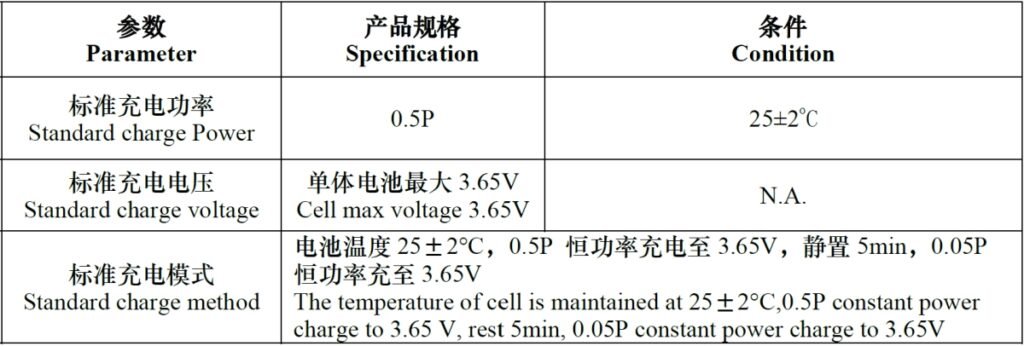
Most stationary battery cells are rated around 0.5C continuous, meaning the battery can charge or discharge at half its rated current — in theory, a full charge from empty in about 2 hours. For most residential ESS applications, that’s more than sufficient, since these batteries are typically sized to support the load for longer than 2 hours anyway. Commercial applications often demand more: fast-charging use cases may require 1C or higher, meaning a full charge or discharge cycle in around an hour. Faster charge and discharge rates generate heat more quickly inside the cells, which is why high-C-rate systems typically need more advanced thermal management to keep cell temperature in an optimal range.
It’s also worth understanding that the same cell doesn’t perform identically in every condition — its real-world discharge capability shifts with:
- Temperature
- State of charge (SOC)
- Cell chemistry and internal design
- Charging or discharging conditions
- Pack configuration
- BMS current limitations
A cell rated for a given C-rate on a datasheet is being tested under specific, controlled conditions — which is exactly why C-rate and capacity need to be read together, not separately. This naturally leads into a related, and often conflated, specification: power.
3. Power Rating — kW Is Not Just Another Way of Saying kWh
Energy and power are not the same thing, and a spec sheet that’s clear on one can be vague on the other. A battery might hold 15kWh of energy and still be genuinely unsuitable for a high-power application, because energy tells you how much work the battery can do over time, while power tells you how fast it can do it.
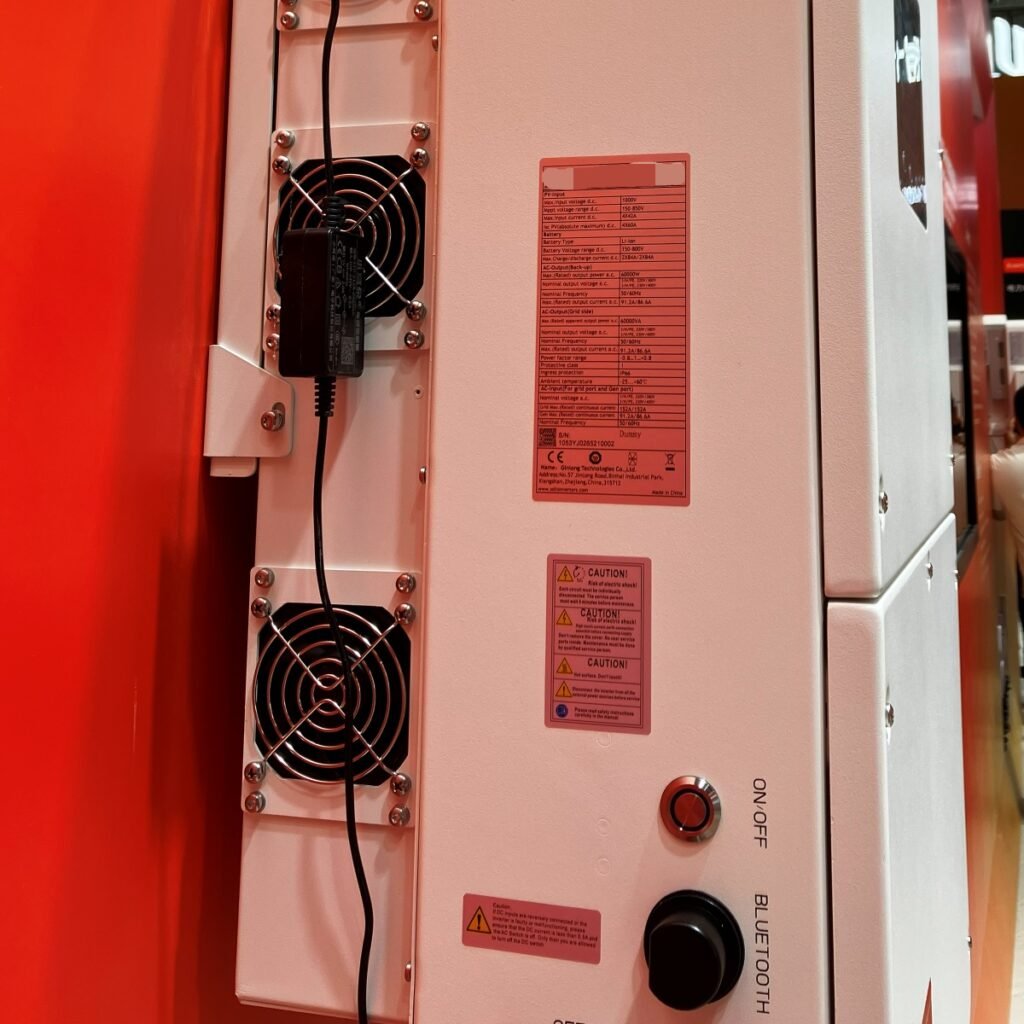
When a manufacturer publishes a power specification, it’s worth digging into what that number actually represents:
- Continuous discharge power — what the system can sustain indefinitely
- Short-duration peak power — what it can deliver briefly, often for seconds
- Charge power — which can be rated differently from discharge power
- Inverter-limited power — the ceiling imposed by the inverter, not the battery
- BMS-limited current — a software/hardware limit set inside the battery itself
- Cell-limited current — the underlying physical limit of the cells
For forklifts, EVs, and certain ESS applications, power capability can matter more than raw capacity. A battery that can’t deliver the current a forklift’s lift motor demands at start-up isn’t the right battery, regardless of how many kWh it holds.
4. Cycle Life — The “10,000+ Cycles” Question
Big cycle-life numbers are easy to claim, because they’re genuinely difficult to disprove — verifying 10,000 cycles requires years of real-world operation or accelerated testing that few buyers are in a position to independently confirm.
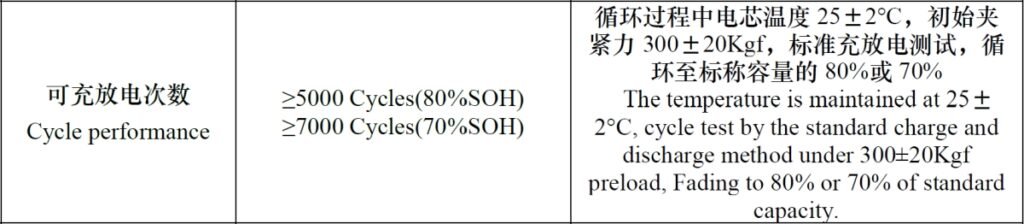
Two things worth understanding before taking a cycle-life number at face value:
First, what actually counts as one cycle? A cycle typically refers to one full charge-discharge equivalent — but how that’s measured (and at what DoD) affects how the number should be interpreted, which connects directly to the next section.
Second, cycle-life numbers are almost always cell-level, tested under specific temperature conditions — not necessarily representative of how that same cell behaves once it’s grouped into a complete battery pack. This doesn’t automatically mean pack-level cycle life is lower; a well-designed pack can get close to the underlying cells’ rated capability. But the pack’s real-world cycle life can end up limited by factors that have nothing to do with the individual cell’s rating:
- Cell-to-cell imbalance
- BMS operating limits
- Thermal differences across the pack
- Busbar and connection quality
- Different aging rates between cells
- High-current operation
- Assembly quality and process control
On top of these physical and manufacturing factors, the actual conditions the battery experiences in service also shape real cycle life: depth of discharge, charge/discharge rate, temperature, charge voltage, discharge cut-off, rest periods between cycles, and — critically — how “end of life” is even defined. An 80% capacity threshold and a 60% threshold produce very different cycle counts for the exact same battery, and not every datasheet states which one its number assumes.
The point worth remembering for any B2B buyer: a cell’s cycle-life specification is not necessarily the same as the cycle life of the complete battery pack built from it. Ask for pack-level test data, not just the cell datasheet.
5. Depth of Discharge — Why 100% DoD Isn’t Always the Goal
This connects directly to cycle life. Deeper discharge means more usable energy per cycle — but it also tends to mean more stress on the cells, and potentially a shorter cycle life as a result.
That relationship doesn’t point to one universally “correct” DoD. Different operating strategies trade off differently:
- 100% DoD — maximizes usable energy per cycle, at the cost of more stress per cycle
- 90% DoD — a common middle ground for many stationary applications
- 80% DoD — a more conservative setting that trades some usable capacity for longevity
- 70% DoD — favors cycle life and long-term consistency over per-cycle energy
The real trade-off is between usable energy per cycle and total lifetime energy throughput — and those two goals don’t always point in the same direction. This raises a more interesting question than “how many cycles can this battery achieve”: is chasing the highest possible cycle count actually the best way to design a battery system?
Not necessarily. A battery designed for 8,000 cycles may be more than adequate if the actual application only calls for a few hundred cycles a year — the extra rated cycle life simply goes unused. Meanwhile, restricting a battery to an unnecessarily conservative operating window can extend cycle life on paper while reducing the real economic value of the capacity you paid for. The right DoD strategy depends on the application’s actual usage pattern, not on maximizing a single spec in isolation.
6. Operating Temperature — The Specification That Changes Everything
Temperature range on a datasheet is easy to skim past, but it’s one of the specifications that most directly affects everything else already discussed — cycle life, usable capacity, and safe operating limits all shift with temperature.
It’s worth separating three distinct temperature specs, since they aren’t interchangeable:
- Charging temperature range
- Discharging temperature range
- Storage temperature range
Charging at low temperatures is a particular risk area for lithium chemistries generally — it can cause lithium plating on the anode, which is both a safety and a longevity concern, which is why many BMS designs restrict or block charging below a certain temperature entirely. At the high end, sustained high-temperature operation accelerates aging and can cause both temporary and permanent capacity loss, even when the battery stays technically within its rated range.
It’s also worth keeping in mind that a battery’s headline specifications are usually established under controlled test conditions — a stable lab temperature, not the swing between a hot afternoon and a cool night that an outdoor installation actually experiences. Real installations rarely operate at the single temperature point the datasheet numbers were tested at, which is exactly why thermal management design matters as much as the cell chemistry itself.
7. Dimensions & Weight — Electrical Specifications Aren’t Enough
This is especially relevant for replacement and OEM/ODM buyers, where the battery has to fit into a space and a mounting configuration that already exists.

Worth checking, beyond the electrical spec sheet:
- Overall dimensions
- Mounting position and orientation
- Terminal location
- Connector type
- Cable arrangement and routing
- Weight
- Enclosure type
- IP rating
- Installation orientation (some batteries have orientation restrictions)
The practical point is simple: a battery can meet every electrical specification on paper and still be the wrong battery if it doesn’t physically fit the equipment, the compartment, or the mounting hardware it needs to replace. This is exactly the kind of mismatch that shows up late in a project — after the electrical spec has already been approved — which is why physical fit deserves the same scrutiny as voltage and capacity, not an afterthought once those numbers check out.
8. Rated Capacity — Look Beyond the Ah Number
Capacity is usually the first spec anyone reads, and often the last one they think critically about. At a more advanced level, the real question isn’t “what is Ah” — it’s what does the manufacturer’s rated capacity actually represent?

A rated Ah figure is a result, not a fixed physical constant, and several test conditions sit behind it:
- Test current — capacity measured at a slow discharge rate reads higher than the same cell discharged quickly
- Test temperature — capacity is temperature-dependent, and the rated figure assumes a specific test temperature
- End-of-discharge voltage — where the test stops counting capacity also affects the final number
- Cell capacity vs. pack capacity — a pack’s usable capacity isn’t simply the sum of nominal cell capacities once matching, balancing, and BMS reserve are accounted for. There’s also a further layer of loss on top of that: inverter conversion efficiency, typically above 90%, during the DC-to-AC conversion step — so the energy you can actually draw as usable AC power is smaller again than the pack’s own usable DC capacity.
- Initial capacity vs. capacity after aging — the rated Ah is a day-one number, not a guarantee over the battery’s life
- Capacity tolerance between individual cells — cells are manufactured within a tolerance band, not to one exact identical figure
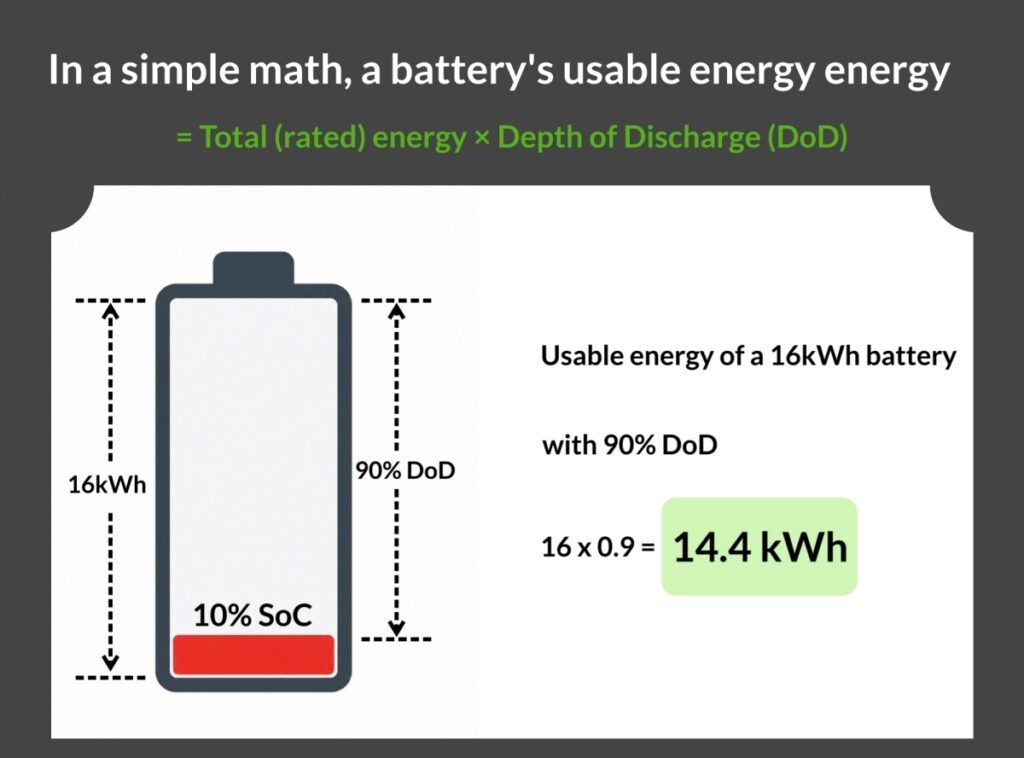
The concept worth taking away: rated capacity is a starting number, not the energy you actually get to use. Take a 16kWh battery as an example. If the system is set to operate at 90% DoD, the usable energy on paper is 16 × 0.90 = 14.4kWh. But that’s still DC energy inside the battery — once it passes through the inverter’s DC-to-AC conversion step, typically around 95% efficient, the actual usable AC energy works out to 14.4 × 0.95 ≈ 13.68kWh. That’s the number that actually matters to the end user, and it’s meaningfully lower than the 16kWh printed on the spec sheet — not because anything is wrong with the battery, but because rated capacity, DoD, and conversion efficiency are three separate numbers that all have to be multiplied together to get a real answer.
Final Thought
None of these eight specifications are wrong on the datasheet — they’re accurate under the conditions they were measured. The mistake isn’t reading the number; it’s assuming the number holds regardless of temperature, current, pack configuration, or how “capacity,” “cycle,” or “power” was actually defined in the test. A buyer who asks what’s behind each of these eight numbers is in a much stronger position than one who simply compares them side by side.