
All-in-One ESS vs Modular ESS: What’s the Difference?
When buyers compare energy storage systems, the conversation usually starts with capacity and price. But there’s an architectural decision that comes before either one: is the system built as a single integrated unit, or assembled from separate modules?
All-in-One ESS vs Modular ESS which determines how the system gets installed, how it’s serviced, whether it can grow later, and how much total space and labor it demands. Neither approach is better in the abstract — but one of them is usually better for a specific project.
What Is an All-in-One ESS?
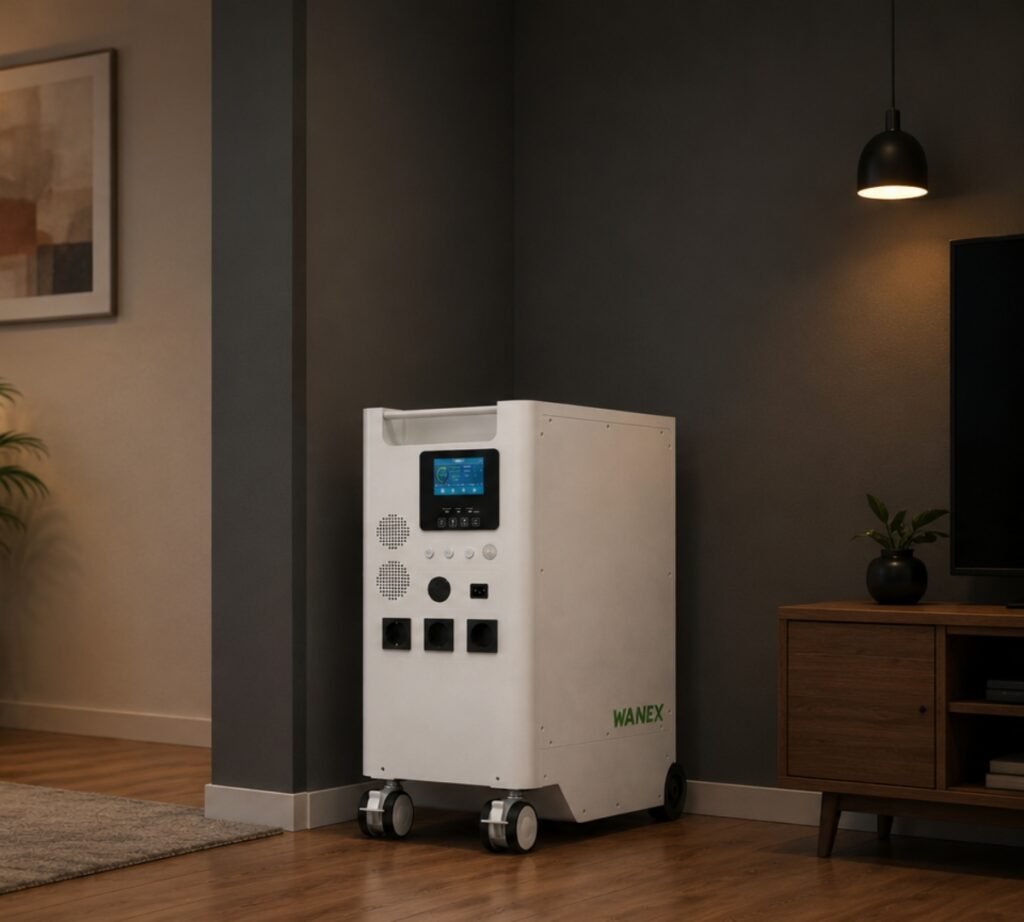
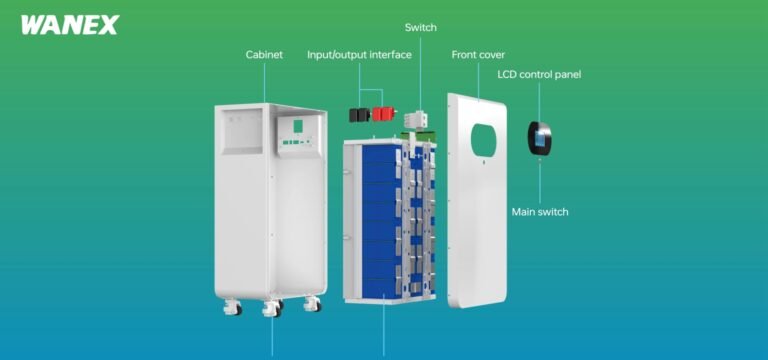
An all-in-one ESS integrates the major equipment into a single unit: battery, hybrid inverter, BMS, and supporting components, usually with DC input ready for solar panels. Everything arrives as one product, from one manufacturer, with one set of internal connections already made and tested at the factory.
The most familiar example is the portable power station — typically 300W to 1,000W of output with 500Wh to 5kWh of battery energy. As home storage adoption grew, the same integrated concept scaled up: a typical residential all-in-one now packs 3kW to 10kW of power with 5kWh to 30kWh of battery energy.
What Is a Modular ESS?
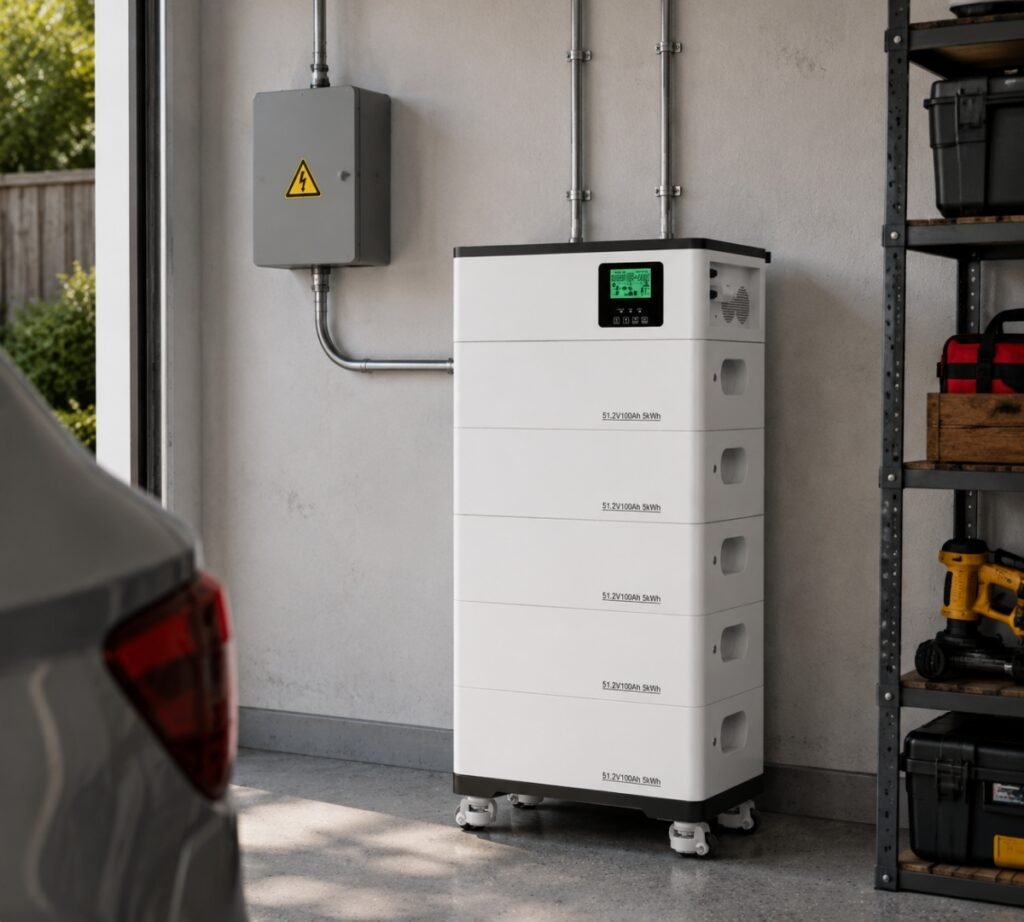
A modular ESS breaks the same functions into separate units — battery modules, and often a separate inverter — that connect together on site.
The design driver is mostly practical: transport, handling, and labor. Keeping each module under 25kg means one person can carry it, which matters for both cost and local regulations on manual handling. Click-to-connect designs let battery modules stack one after another, so capacity is set by how many modules are installed rather than fixed at the factory.
All-in-One vs Modular: The Core Trade-off
Both architectures are available in low-voltage and high-voltage designs — that’s a separate decision from integrated versus modular, and the two shouldn’t be conflated.
The real trade-off is this: all-in-one optimizes for simplicity, modular optimizes for flexibility. An integrated unit arrives pre-engineered and factory-tested, which removes variables. A modular system arrives as parts, which adds installation complexity but lets the system match the site and change later.
Everything below is a consequence of that one difference.
Installation: Which System Is Easier to Install?

For residential projects, modular is generally easier to get into position. The system breaks down into several identical modules, each light and small enough to handle without equipment — which matters more than buyers expect when the installation path involves stairs, tight corners, or a narrow corridor.
The trade-off is that modular systems have more connections to make and verify between modules, so installation must be done by qualified professionals who will check and inspect every inter-module connection and the associated wiring.
All-in-one is closer to plug-and-play once it’s in place, which genuinely simplifies commissioning. Getting it in place is the harder part: the weight of an integrated unit usually requires lifting equipment and careful positioning, and that becomes a real constraint in a stairway or a condominium.
Either way, connection to the main AC distribution — and to the solar PV system, where one exists — requires qualified electrical personnel. Neither architecture is a DIY product.
Scalability: Which Is Better for Future Expansion?
On paper, modular wins outright. In practice, the answer depends on whether expansion is actually going to happen.

Most homeowners do some form of capacity planning before buying, and a well-planned system generally shouldn’t need expanding just because consumption edged up slightly. Modular’s advantage isn’t that it lets you correct a sizing mistake — it’s that it accommodates a structural change in consumption: adding an EV, adding a heat pump, extending the house, or moving from partial backup to whole-home backup.
So the useful question isn’t “do I want expandability?” — almost everyone says yes — but “is there a specific, foreseeable change that would require more capacity?” If yes, modular is worth the premium. If the load profile is stable and well understood, that flexibility may go unused.
One caveat worth raising with any modular supplier: expansion usually isn’t open-ended. Adding modules years later can run into compatibility limits, discontinued product lines, or the practical problem of mixing new modules with aged ones. Ask what the maximum supported configuration is, how long modules will remain available, and whether mixing production batches is supported.
Maintenance and Repair
This is where the two architectures diverge most sharply, and where the draft’s intuition needs splitting into two separate questions.
Troubleshooting is generally simpler with all-in-one. There’s one manufacturer, one integrated control system, one set of diagnostics, and no ambiguity about which component is responsible — a significant advantage when something goes wrong and vendors might otherwise point at each other.
Component replacement is generally simpler with modular. If one battery module fails, it gets swapped while the rest of the system keeps running. In an integrated unit, a failure in the inverter section or battery section often means servicing or replacing a much larger assembly — sometimes the entire unit.
That difference drives everything else:
- Downtime — modular can often degrade gracefully, running at reduced capacity while a module is replaced. An all-in-one fault is more likely to take the whole system offline.
- Spare parts — modular requires the supplier to keep compatible modules available for years. All-in-one shifts that burden to whole-unit replacement or factory service.
- Accountability — all-in-one gives you one warranty and one party responsible. Modular systems, especially when battery and inverter come from different manufacturers, can create gaps where responsibility is contested.
Neither is universally lower-maintenance. All-in-one is easier to diagnose; modular is easier to repair.
Space Requirements
All-in-one is more space-efficient in absolute terms, since the packaging is engineered once around a fixed set of components.
Modular systems need more total volume, plus clearance for stacking, module access, and any future modules the owner plans to add. Installed footprint is the thing to check — not just the dimensions of the equipment, but the service clearance the manufacturer requires around it.
Cost Comparison
Equipment cost alone rarely settles this. The comparison worth running covers:
- Equipment cost — integrated units often cost less per kWh at small capacities, where a single enclosure and shared electronics avoid duplication.
- Installation cost — modular usually costs less to get on site and into position, especially in difficult access conditions; all-in-one may require lifting equipment. Modular’s inter-module connections add commissioning labor back.
- Balance-of-system costs — mounting, cabling, protection devices, and enclosure requirements differ between the two and are easy to underestimate.
- Long-term maintenance and expansion — component-level replacement versus whole-unit replacement, and whether future capacity requires new equipment or just additional modules.
The lowest initial price isn’t necessarily the lowest total cost. An all-in-one that has to be replaced entirely because one section failed outside warranty can easily cost more over ten years than a modular system with a higher purchase price and cheaper failure modes.
Which Is Better for Residential Solar Storage?

Neither is categorically better — they have genuinely distinct advantages.
For portable applications, all-in-one is clearly the right fit; that use case is defined by integration. For residential storage, it depends on three things: actual consumption pattern, installation conditions, and how likely the requirement is to change.
A stable load profile, a straightforward installation path, and no foreseeable expansion point toward all-in-one. Difficult access, uncertain future demand, or a planned EV point toward modular.
Which Is Better for Commercial and Industrial Applications?

Small commercial applications tend toward all-in-one designs, with variants configured for the intended purpose — energy arbitrage, peak shaving, or load shifting — and for functional requirements like solar PV integration, microgrid formation with diesel generator compatibility, or seamless transfer switching for critical loads. Standard all-in-one cabinets in this segment commonly run 100kW or 125kW of power with battery energy around 241kWh, 261kWh, or 379kWh.
At larger commercial and utility scale, all-in-one designs are mostly absent. These systems typically operate above 1000V, where the governing concerns become safety, clear responsibility, and functional reliability. Battery, power conversion system, and auxiliary equipment also come from genuinely different industries — battery from electrochemistry, PCS from power electronics — and separating the major equipment helps mitigate risk rather than concentrate it.
There’s a useful principle underneath this: integration makes sense where the system is small enough that one manufacturer can competently own the whole thing, and stops making sense at the scale where specialization matters more than convenience.
How to Choose Between All-in-One and Modular ESS
Choose all-in-one when:
- Capacity requirements are modest and well-defined
- The application is portable, or the installation location is fixed and accessible
- Single-vendor accountability matters more than component-level serviceability
- Space is tight
- Installation should be as simple and fast as possible
Choose modular when:
- Access to the installation site is difficult — stairs, narrow corridors, upper floors
- Capacity requirements may change structurally (EV, heat pump, expansion)
- Component-level replacement and minimal downtime are priorities
- Local labor regulations or costs favor lighter, single-person-handling units
- The project benefits from matching capacity precisely rather than buying a fixed size
Questions to ask before ordering:
- What’s the maximum supported capacity, and how many modules can be added?
- How long will compatible modules remain available?
- Can modules from different production batches be mixed?
- Is the warranty single-source, or split between battery and inverter?
- What’s the service process for a failed component — on-site replacement, or return to factory?
- What are the installed footprint and required service clearances?
- What’s the weight of the heaviest single piece that has to be carried in?
Quick Comparison
| Perspective | All-in-One | Modular |
| Installation (positioning) | Harder — heavy, may need lifting equipment | Easier — light, single-person modules |
| Installation (commissioning) | Simpler — largely plug-and-play | More connections to make and verify |
| Scalability | Poor — capacity fixed at purchase | High — add modules as needed |
| Flexibility | Poor | Great |
| Troubleshooting | Easier — one vendor, one system | Moderate — more interfaces |
| Component replacement | Harder — often whole-unit service | Easier — swap individual modules |
| Downtime on fault | Usually full system offline | Often partial capacity maintained |
| Space | Minimum | Moderate, plus expansion clearance |
| Accountability | Single vendor | May be split across suppliers |
| Cost | Depends on capacity and site | Depends on capacity and site |
Conclusion: Choose the Architecture That Fits the Project
There’s no universal winner here. All-in-one and modular solve different problems, and both are correct answers to the right question.
What matters is matching the architecture to the application, the capacity required, the physical realities of the installation site, and how likely the requirement is to change over the system’s life. A buyer who works through those four factors honestly will usually find the answer is obvious — and that it’s not the same answer for every project.
If you’d like a second opinion on which architecture suits a specific project, we’re happy to talk it through — we build both all-in-one and modular systems for residential and commercial applications, and the right choice depends entirely on the details.