
How to Compare LiFePO4 Battery Suppliers for Residential & Commercial ESS?
Introduction
For years, solar has taken center stage in renewable energy for one simple reason: it’s affordable and decentralized. Many early adopters enjoyed cheaper, sometimes free electricity, along with decent investment returns. But over time, smaller grids have grown saturated as more solar gets added — selling power back to the grid is now either restricted or not allowed at all in a lot of places.
Battery storage came as a natural supplement to that ecosystem. It’s essentially a buffer zone: store the excess energy when you’re generating more than you need, release it when demand calls for it.
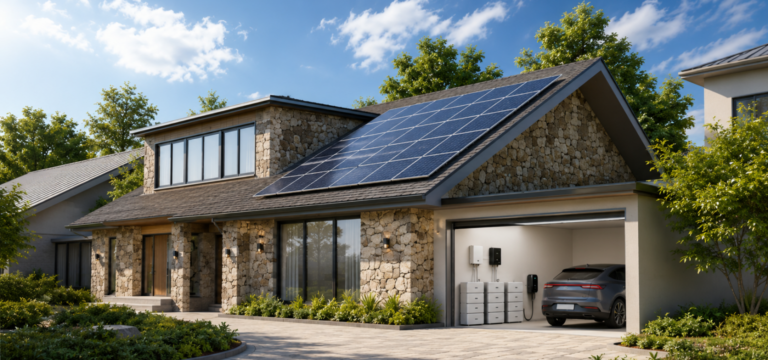
More homes are now moving to solar-plus-battery setups to keep up with rising energy demand — especially once an EV enters the picture and home charging becomes part of the daily load. Most of that battery storage today runs on LiFePO4 (lithium iron phosphate) cells, the chemistry that’s become the default choice for both residential and commercial ESS thanks to its safety profile and long service life.

But once you decide to add battery storage, the harder question starts: which LiFePO4 battery supplier, and how do you actually tell a good one from a risky one? Price, cell quality, BMS compatibility, warranty terms, and support all look similar on paper across suppliers — until you know what to actually check. That’s what this guide walks through.
1. What’s inside a typical residential and commercial ESS
Residential ESS
For many homes already running solar PV, adding a battery usually means replacing the grid-tie inverter with a hybrid inverter, since the system needs to be able to charge and discharge the battery, not just feed power to the grid.

A residential ESS system typically consists of three major parts:
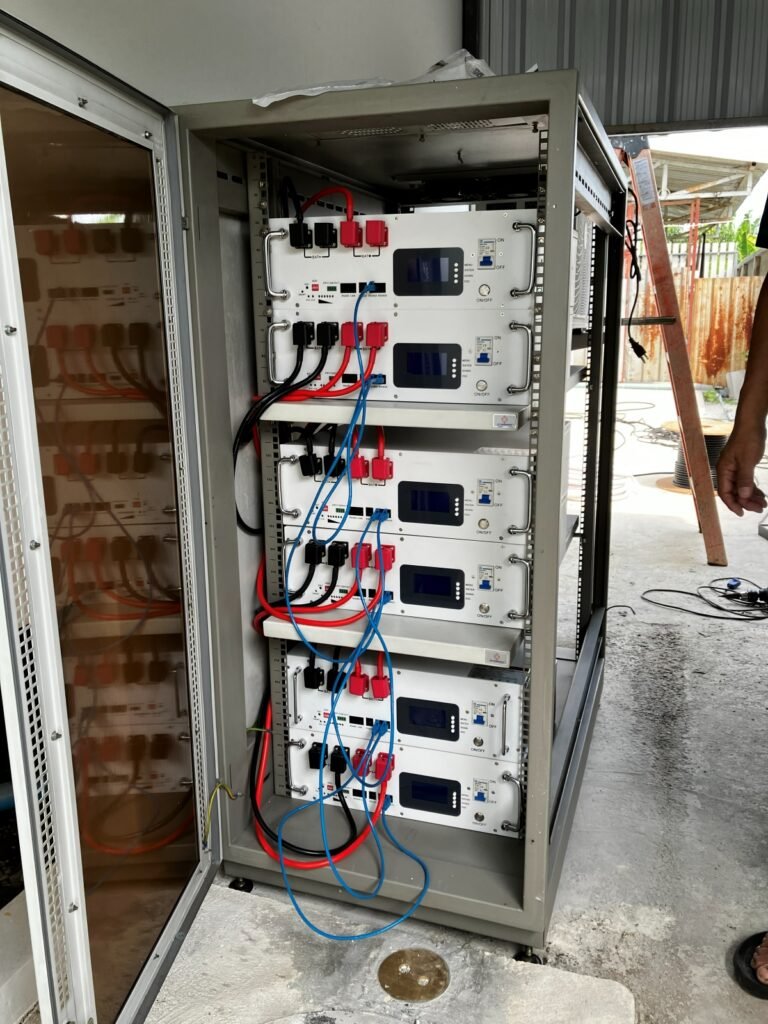
a. Hybrid inverter. Typically sized from 5kW to 25kW depending on the household’s power demand, it manages the flow of power between solar generation, the battery, the home’s load, and the grid.
b. Battery set. Sized from as small as 5kWh up to 32kWh per enclosure, configured based on how much power is generated and how much is left over after self-consumption. As an example: on a site in Minburi, a suburb of Bangkok, the house runs a 10kW solar PV system, an 8kW hybrid inverter, and a 30kWh battery set. About 40% of the PV generation gets consumed immediately, with the rest stored in the battery. Roughly, a 10kW PV system generates around 41kWh per day on average, leaving about 24kWh available to store. That’s enough for the homeowner to charge his EV daily without wasting any power the PV system produces.
c. Accessories. DC breakers, cabling, and other supporting hardware needed to complete the installation.
For a brand-new solar-plus-battery installation, an all-in-one ESS is usually the better choice — the hybrid inverter comes integrated into the battery as one complete enclosure. Beyond saving installation time and space, it also reduces the wiring and electrical work needed between a separate inverter and battery, and it looks cleaner and more unified once installed.
Commercial ESS
Commercial ESS requires considerably more design consideration from the outset. A standard commercial ESS cabinet typically includes:

a. Battery packs, standardized for easy stacking, cooled either by fans or, in more advanced systems, liquid cooling.
b. HV module. Commercial ESS cabinets often run at high voltage, in the 1000V–1500V range, which requires a dedicated BMS and pre-set connections for proper management and safety.
c. Air conditioning or chiller module, to maintain optimal internal temperature.
d. Fire suppression system, often aerosol-based, paired with sensors that detect cabinet temperature as a safety precaution against thermal runaway.
e. Accessories, including essential connective hardware — copper bars, breakers, wiring harnesses, and liquid cooling pipes.
f. Body enclosure. Often rated at IP54, since most commercial cabinets are installed under some form of proper sheltering. For larger commercial projects, IP68-rated cabinets are also available for outdoor use, where wiring often runs underground.
g. Optional equipment. Depending on the use case, this can include an STS (seamless transfer switch) for critical-load applications like banks or data centers that need seamless switching between utility and renewable power, or a DC conversion module for solar PV DC coupling.
There’s also a non-integrated form, where the ESS is housed alongside separate air conditioning and fire alarm systems. This setup is simpler, and often comes with the hybrid inverter and battery set kept separate — similar to the residential configuration described above. It’s easier to maintain and more flexible for future expansion, though it trades away some of the space and installation efficiency of an all-in-one design.
2. Price: what you’re actually paying for
Price comparisons between suppliers get misleading fast if you’re only looking at the headline number. A few things worth checking before you compare quotes side by side:
Per-kWh price vs. bundled system price. A quote built around battery cost per kWh looks straightforward, but make sure you know what else is bundled in — or not. Installation, hybrid inverter, monitoring software, shipping, and commissioning can all be quoted separately or folded into the number, and two suppliers with the same headline price can end up costing very differently once everything’s accounted for.
What’s driving the number. The same nominal kWh capacity can come from very different cell grades, BMS sophistication, and enclosure quality. This is where price and cell quality connect directly — a supplier quoting noticeably below the market for the same spec sheet is worth a closer look at exactly what cells are inside, which is what the next section covers.
Warranty and support baked in, or add-on. Some suppliers price a stronger warranty or faster support response into the base cost; others treat it as an optional extra. Worth clarifying upfront rather than discovering it later.
None of this means the cheapest quote is automatically suspect — but a price that looks unusually good relative to the rest of the market is a signal to ask more questions, not a reason to skip them.
3. The tricky part: battery cells
As someone who’s worked in the battery business for over five years, I’ve watched a lot of companies come and go in the residential sector — and almost every failure I’ve seen traces back to the same root cause: the cells.

The battery cell is, without question, the most important and critical part of any battery storage system. When you have hundreds of cells grouped together, cell consistency is extremely important for thermal stability and charge/discharge performance. Even with active balancing — a feature now available in many BMS solutions — cell consistency still matters enormously for a system’s long-term stability and performance.
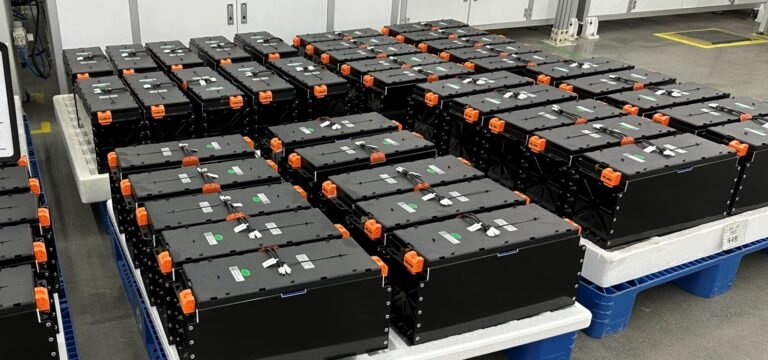
Engineers at reputable factories know this, and they work to avoid inconsistency by sticking to identical production lots and sorting cells based on voltage readings before assembly. But it still happens: cells from different production batches, different ages, and in the worst cases, retired EV cells or cells that have sat in storage for 6 to 12 months, end up in low-end residential battery products.
That risk shows up along two different dimensions: how long cells sat before use, and where they actually came from.
By storage age:
- Under 6 months in storage is generally considered safe, with minimal concern about capacity loss or inconsistency.
- Over 6 months in storage requires additional verification — capacity and electrical characteristics should be reconfirmed before the cells go into production, since self-discharge and calendar aging start to matter at this point.
By origin:
- Retired EV cells are the highest-risk category. These are cells pulled from decommissioned electric vehicles and resold into the residential storage market. They require specialized equipment to properly assess battery health and remaining capacity retention — equipment most buyers, and frankly most installers, don’t have access to.
- Disassembled cells from cancelled or returned projects are a less obvious but genuinely tricky category. These are cells that were manufactured as brand new, then pulled from finished battery packs or projects for reasons unrelated to the cells themselves — a project got cancelled, the cells sat in storage past a stipulated time limit (often 6 months), or the batch was returned to the manufacturer over a business dispute. In short: the cells started life as legitimately new product, but ended up recirculated into the market as second-hand — and unless you know to ask, there’s often nothing visibly different about them from genuinely new stock.
The hard truth is that it’s extremely difficult to spot these differences with the naked eye. Even with testing tools, the cost of verification often isn’t justified for a single residential purchase — which is exactly why it falls on you to ask the right questions upfront, rather than try to inspect your way out of the problem after the fact.
How to avoid buying a problem battery
A few practical checks that go a long way:
Ask who makes the cells. This is probably the single most useful thing you can do. Cells from established, well-known manufacturers (CATL, Hithium, REPT, and EVE are a few of the more recognizable names, though there are other legitimate established makers beyond this short list) generally carry lower risk than cells from lesser-known or narrowly-used makers. A supplier unwilling or unable to name their cell source is a red flag on its own.
Confirm the cell source, and track the batch info if you can. Naming a well-known cell maker isn’t the full picture on its own — a meaningful share of the repurposed, disassembled, and cancelled-project cells described above also originate from these same established manufacturers. The cells themselves were made properly; what matters is what happened to them afterward. Where possible, ask for the actual batch or lot number and cross-check it, rather than treating a recognizable brand name as confirmation that the cells are new.
Ask about the manufacturing process, and ask for video of it. How cells are sorted, matched, and tested before assembly into packs is worth understanding — and asking for actual video of that process, not just product photos, is the most reliable way to confirm it’s real. A legitimate manufacturer should have no problem showing you a real production line. If a “manufacturer” keeps redirecting you to product photos instead of video of cells actually being made, that hesitation is itself the answer.
4. BMS: what to actually compare
The BMS (battery management system) doesn’t get the attention it deserves in most buying decisions, partly because it’s invisible — you can’t see it the way you can see a cell or an enclosure. But it’s doing the real work of keeping the cell inconsistency described above from becoming a safety or performance problem. A few things worth comparing between suppliers:

Cell balancing quality. Active balancing (which actively redistributes charge between cells) is generally more effective than passive balancing (which simply bleeds off excess charge from the stronger cells). Ask which type is used, since it directly affects how well the system compensates for the kind of cell inconsistency discussed above.
Temperature and fire protection. What temperature thresholds trigger a shutdown or alarm, and how that integrates with any fire suppression system in commercial installs.
Remote monitoring and app control. For residential buyers especially, this matters day to day — being able to check state of charge, generation, and consumption from a phone app is now a standard expectation, not a premium feature.
Proprietary vs. third-party BMS. A proprietary, in-house BMS can mean tighter integration and optimization, but it can also mean you’re dependent on that one supplier for any future service or replacement. A widely-used third-party BMS platform can be easier to service down the line if your original supplier becomes hard to reach.
5. Warranty: what’s actually covered
This reminds me of the solar panel era. Rated power on a solar panel is always tied to a specific temperature, because a panel’s electrical characteristics shift depending on how hot or cold it is — so the industry settled on room temperature as the standard baseline for rated performance. Battery cells work the same way.

Most battery cells carry a rated cycle life — commonly around 7,000 cycles to 80% SoH — measured at 25°C, based on roughly one cycle per day at a maximum 0.5C charge/discharge rate. If the system actually operates above or below that temperature, or cycles more than once a day, a 3- or 5-year warranty may simply not apply the way you’d expect when you go to file a claim.
Beyond that temperature and cycling fine print, a few other things worth checking in any warranty before you buy:
- What’s covered: typically manufacturing defects and capacity retention falling below a stated threshold (often 70-80% SoH) within the warranty period.
- What’s excluded: physical damage, water damage, unauthorized modification, and — as above — operation outside the rated temperature or cycling conditions.
- Length differences: residential systems commonly carry 5-10 year warranties, while commercial systems can vary more widely depending on cycling intensity and application.
- Transferability: whether the warranty stays with the system if the property or business changes hands, which matters more than people expect for resale value.
6. Support: what it actually means
“Support” gets used as a catch-all term, but it’s worth splitting into what you actually need before the sale versus after it.
Pre-sale support covers things like system sizing help, site assessment, and design assistance — particularly relevant for commercial projects with more configuration variables, but also useful for residential buyers unsure what capacity actually fits their usage pattern.
Post-sale support is where most of the real difference between suppliers shows up: how quickly they respond when something goes wrong, whether replacement parts are actually in stock and available in your region, and whether you’re dealing with the manufacturer directly or routed through a reseller with limited authority to solve problems.
Before committing, it’s worth asking a supplier directly: what’s your typical response time on a support ticket, and can you show me an example of how you’ve handled a real issue for another customer. A supplier’s answer to that question — vague and reassuring, versus specific and concrete — tells you a lot about which kind of support you’re actually going to get.
Closing checklist
Before you commit to a LiFePO4 battery supplier for a residential or commercial ESS project, run them through this:
- Do you know exactly what’s bundled into the quoted price, and what’s billed separately?
- Have you asked who manufactures the cells, and confirmed the source?
- Has the supplier shown you real evidence of their manufacturing process — video, not just photos?
- Do you know whether the BMS uses active or passive balancing, and whether it’s proprietary or third-party?
- Have you read the warranty’s fine print on temperature and cycling conditions, not just the headline years?
- Do you know what pre-sale and post-sale support actually looks like in practice, not just in the sales pitch?
Get more than one supplier through this list side by side. The gaps that show up — in transparency, in specifics, in how a supplier responds to a hard question — usually tell you more than any spec sheet will.