Beyond Peak Shaving — How Battery Energy Storage Really Makes Money
Most people encounter battery energy storage through two terms: peak shaving and load shifting. They’re the entry point — simple, practical, and easy to grasp. But as you’ll see, they’re only the beginning of what modern battery energy storage systems (BESS) can do.
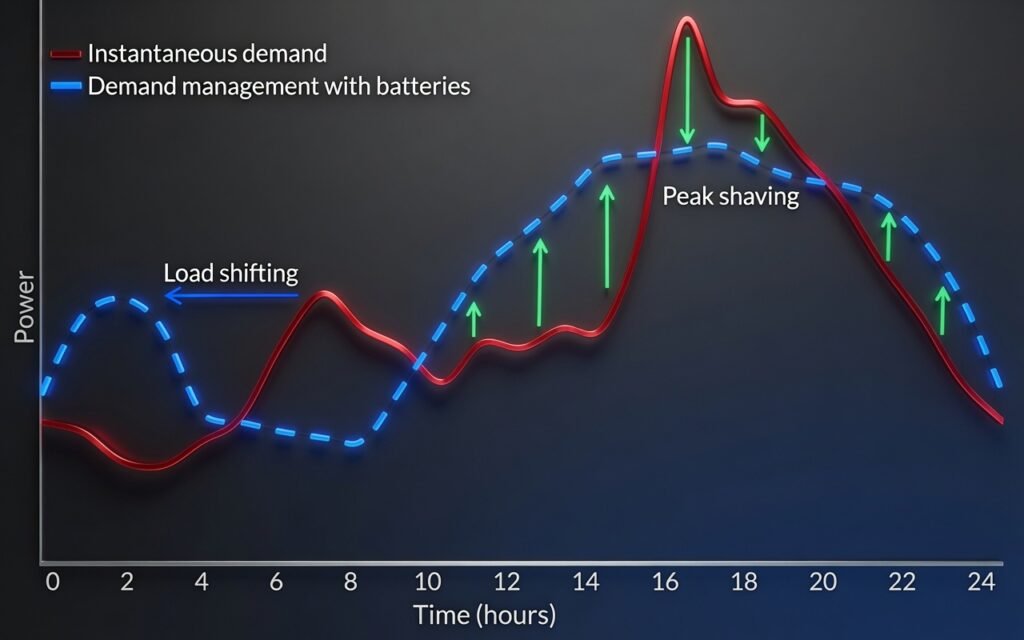
Peak shaving means cutting the amount of power drawn from the grid during peak demand hours. Instead of pulling everything from the grid when electricity is most expensive and most strained, a battery energy storage system (BESS) steps in to cover the gap. The result: lower electricity bills for the user, and less pressure on grid infrastructure.
Load shifting takes a slightly different approach — rather than just filling the gap during peak hours, it reschedules high-consumption operations entirely to off-peak periods when power is cheaper and more available.
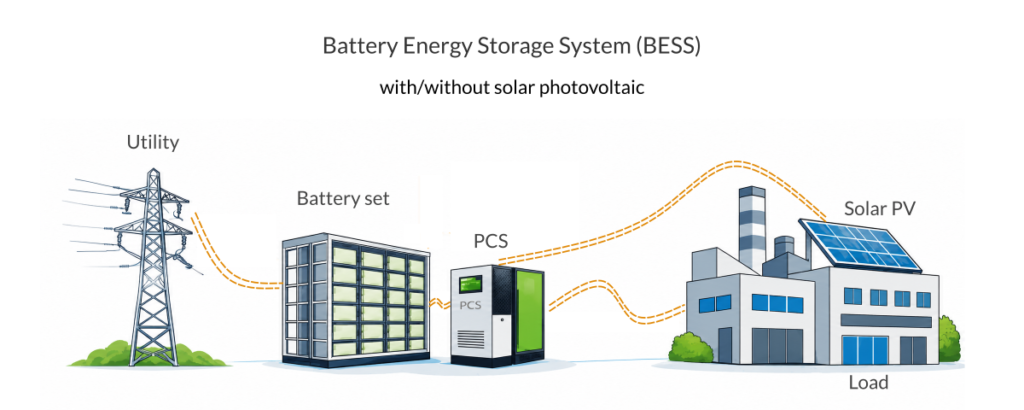
Together, these two strategies form the simplest and most accessible use case for battery storage:
- Charge during off-peak hours (typically overnight, or during low-rate windows under time-of-use tariff schemes)
- Discharge during peak hours when grid electricity is expensive
On the grid side, this smooths demand curves and reduces the need to build additional generation capacity that would otherwise sit idle most of the day. On the user side, it directly cuts electricity bills.
Beyond the Basics: Peak Shaving Is Just the Starting Point
For a battery energy storage system, peak shaving and load shifting are the entry point — not the ceiling. The real case for energy storage investment lies in a stack of value-added functions that now represent the majority of revenue in mature energy storage projects. This is the core reason why energy storage has emerged as one of the biggest beneficiaries of power market liberalisation.
The full value stack breaks down into two tiers: basic value and value-added value, both increasingly translating into concrete revenue.
Tier 1 — Basic Value: Peak-Valley Arbitrage
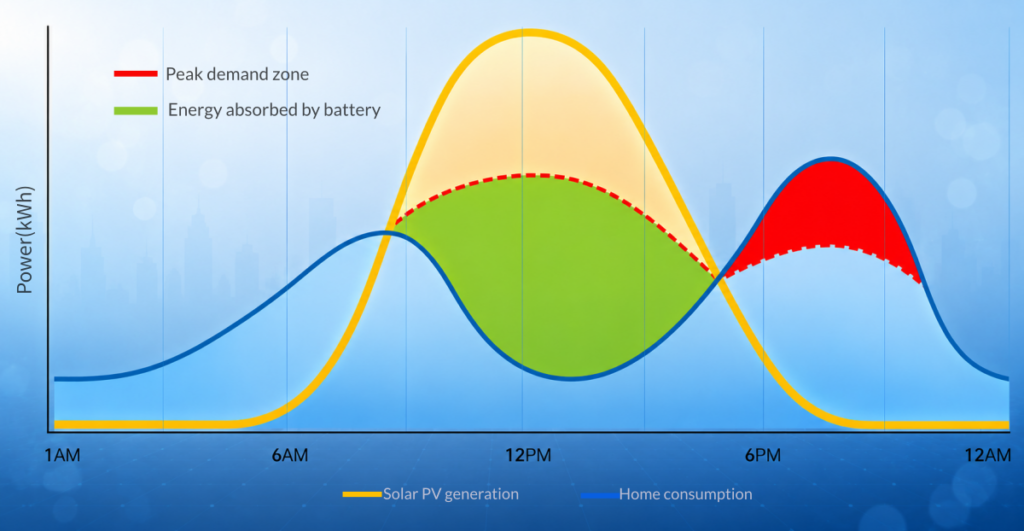
This is the most straightforward profit model. Buy electricity at low prices during off-peak hours, store it, then discharge and sell (or self-consume) during peak hours, earning the spread between the two rates.
As electricity markets deepen, this spread continues to widen. In Guangdong province, for example, the peak-to-valley price difference has exceeded ¥1.2/kWh; Shandong has introduced deep-valley discounts reaching 90% off standard rates. Under these conditions, independent and user-side energy storage projects are achieving internal rates of return (IRR) of 15%–25% on this arbitrage alone — giving the model a solid financial foundation before any value-added services are factored in.
Tier 2 — Value-Added Functions: Where the Real Revenue Growth Is
This is what separates energy storage from other demand-side management tools. Its millisecond-level response speed and precise output control give it capabilities that thermal and hydro plants simply cannot match.
2.1 Frequency Regulation
Grid frequency must stay within a narrow band to keep power systems stable. When supply and demand fall out of balance, frequency drifts — and correcting it fast matters. Thermal power plants respond in minutes; battery storage responds in milliseconds.
This precision commands a significant premium. Frequency regulation services are bid and priced separately from basic peak shaving, and the economics reflect the difference: a 200 MW independent energy storage project can generate over ¥65 million per year in frequency regulation revenue alone. In some projects, frequency regulation and ancillary services now account for up to 70% of total revenue.
2.2 Renewable Energy Integration
Solar and wind power are intermittent by nature — output fluctuates with weather, and generation peaks don’t always align with demand peaks. Pairing storage with renewable plants smooths these fluctuations, improves grid connection rates, and helps prevent curtailment (wind and solar power that gets generated but can’t be absorbed by the grid and is simply wasted).
China currently mandates that new renewable energy projects include 10%–20% energy storage capacity (with 2–4 hours of duration), which studies show can increase usable renewable output by 8%–12%.
2.3 Emergency Backup and Black Start
Energy storage can serve as a reliable backup power source for critical facilities — industrial parks, data centres, hospitals — during grid outages. It can also support black start operations: providing the initial power needed to restart thermal generators after a complete grid failure, a capability that takes on outsized importance for grid resilience. This system-security value is partly reflected in capacity compensation subsidies, but represents a core pillar of the case for grid-side energy storage.
Tier 3 — Market-Driven Arbitrage: Stacking Multiple Revenue Streams
As spot electricity markets and ancillary services markets open up, energy storage is no longer just a tool — it’s becoming a market participant in its own right, capable of capturing value across multiple mechanisms simultaneously:
- Spot market arbitrage — capturing real-time price fluctuations throughout the day
- Capacity compensation — fixed payments from grid operators for making peak-shaving capacity available
- Demand response — subsidies for actively discharging during critical peak events
- Virtual power plant aggregation — pooling distributed storage assets and sharing in the aggregation premium
The Bottom Line
Peak shaving and load shifting are the foundation — the predictable, reliable baseline of battery storage economics. Multiple market-driven revenue streams add the elasticity on top.
It is this combination of certainty and upside that makes energy storage’s investment case so compelling, and increasingly difficult to replicate with conventional generation assets. As peak-to-valley price spreads continue to widen and electricity markets continue to liberalise, that investment case only strengthens.