Dying EV Batteries Power a Circular Economy
China has unveiled the world’s first zero-carbon building that combines solar power, retired electric vehicle (EV) batteries, and cutting-edge digital technologies. This innovation not only...

In recent years, sodium-ion batteries have attracted growing attention across the energy storage industry. Much of this interest comes from sodium’s natural abundance. As a widely available element found in salt, seawater, and the Earth’s crust, sodium is far easier and cheaper to source than lithium, which remains geographically concentrated and vulnerable to supply-chain disruptions.
Supporters of sodium-ion technology often highlight several key advantages, including higher safety, faster charging capability, and notably strong performance in cold temperatures—an area where both lithium iron phosphate (LFP) and NCM batteries continue to face limitations.
As the global push for electrification and energy storage accelerates, sodium-ion batteries are increasingly viewed as a potential cost-effective alternative to lithium-ion technologies, particularly in applications where high energy density is not the primary requirement. That said, despite the growing hype, real-world adoption remains limited as of early 2026.
Although commercialization has begun, sodium-ion batteries are still at an early stage compared with the dominance of lithium-ion batteries.
As of 2025, global sodium-ion battery shipments remain relatively small, estimated in the single-digit GWh range, with the majority of deployments concentrated in China. This is still negligible compared to the hundreds of GWh shipped annually for lithium-ion batteries.
China leads sodium-ion development, with several major players actively investing in the technology:
Outside China, companies such as Faradion, now part of Reliance Industries, along with several European startups, are exploring sodium-ion scale-up. Even so, sodium-ion batteries today remain largely confined to niche applications, including stationary storage, low-speed EVs, two-wheelers, and demonstration projects.
In simple terms, a sodium-ion battery operates in much the same way as a lithium-ion battery. During charging and discharging, ions move back and forth between the cathode and anode, storing and releasing energy.
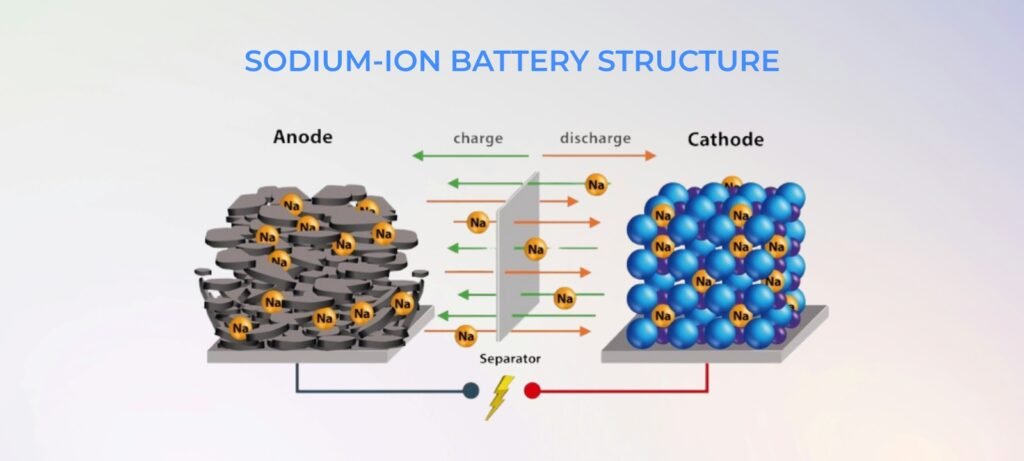
The key difference lies in the charge carrier. Instead of lithium ions, sodium-ion batteries use sodium ions (Na⁺). Sodium’s abundance and low extraction cost make it attractive from both a cost and supply-chain perspective.
Most current sodium-ion designs rely on cathode materials such as layered oxides or Prussian blue compounds, paired with hard carbon anodes. These material choices contribute to improved safety and reduce reliance on expensive or scarce metals.
Sodium-ion batteries demonstrate several clear strengths.
One of the most notable advantages is cold-temperature performance. Compared with LFP and NCM batteries, sodium-ion cells experience far less capacity loss in sub-zero environments, making them well suited for colder regions.
They also support faster charging rates, enabling quicker recharge times without significantly compromising safety.
In addition, sodium-ion batteries offer strong thermal stability, reducing the risk of thermal runaway. Combined with the use of abundant raw materials, this makes them particularly attractive for stationary and industrial energy storage applications.
Despite encouraging progress, sodium-ion batteries still face important limitations.
Energy density remains the most significant challenge. Even the most advanced products currently reach around 175 Wh/kg, while many commercially available sodium-ion batteries remain closer to 120–150 Wh/kg. In comparison, mainstream LFP batteries typically achieve 160–200 Wh/kg, and NCM batteries go well beyond that.
Cycle life is improving but varies widely. Many sodium-ion batteries today claim around 3,000 to 6,000 cycles, placing them between NCM and high-quality LFP batteries.
Cost, often cited as the biggest advantage, has not yet fully materialized. Due to limited production scale and an immature supply chain, sodium-ion batteries in 2025 are frequently priced similar to—or even higher than—LFP batteries, which continue to benefit from massive economies of scale.
Looking ahead, sodium-ion batteries hold meaningful long-term potential.
With abundant raw materials and production processes that are largely compatible with existing lithium-ion manufacturing lines, costs are expected to decline as scale increases. At the same time, continued improvements in materials and cell design are likely to push energy density higher.
However, it is important to recognize that lithium-ion technologies—especially LFP—are also advancing rapidly. Cost reductions and performance improvements are ongoing, which means sodium-ion will need to carve out its role rather than directly replace lithium-ion across all applications.
So, are sodium-ion batteries a cheaper alternative to lithium-ion?
Not yet—but they are becoming increasingly relevant.
For electric vehicles and portable electronics, where weight, size, and driving range are critical, lithium-ion batteries remain the preferred solution.
Sodium-ion batteries, however, show strong promise in areas such as stationary energy storage, grid-scale systems, home backup power, industrial applications, and cold-climate environments—where safety, durability, and temperature performance often matter more than energy density.
Sodium-ion batteries are unlikely to replace lithium-ion batteries in the near term. Instead, they are shaping up to be a complementary technology, helping diversify the battery landscape and improve long-term supply security.
 by
by