How Does an Energy Storage System Work?
Energy storage systems (ESS) are transforming how we manage electricity, enabling a smarter and more efficient way to harness renewable energy. In this blog, we’ll...

At first glance, power battery cells, often called EV-grade cells and energy storage cells, also known as stationary-grade cells may appear very similar. Many lithium iron phosphate (LFP) cells are prismatic with capacities ranging from 50Ah to 300Ah or more, while nickel-cobalt-manganese (NCM or NMC) cells are frequently cylindrical in standardized formats like 18650, 21700, or the larger 4680. In fact, cells from the same manufacturer using identical chemistry can sometimes be used in both applications. However, despite these similarities, power cells and energy storage cells are fundamentally different in their design priorities, material optimizations, and performance characteristics.
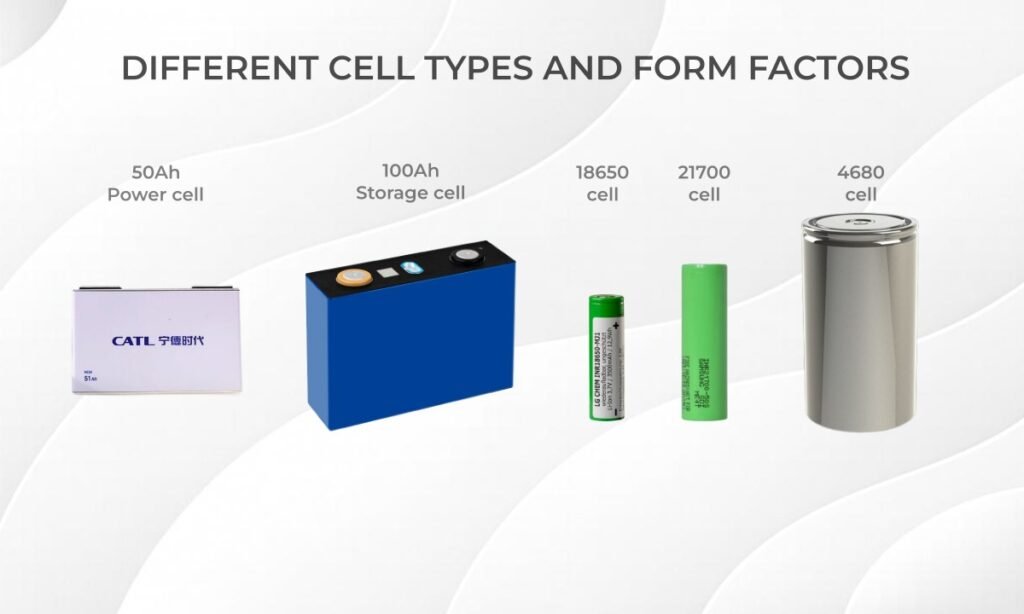
Power cells are designed primarily for electric vehicles (EVs) and high-performance applications, where rapid power delivery, compact size, and lightweight design are critical. In contrast, energy storage cells are tailored for stationary systems such as grid-scale storage, home backups, or renewable energy integration, where longevity, safety, and cost-efficiency take precedence over peak performance.
Below, we explore the key differences across several dimensions: design and materials, energy density, charge/discharge rates (power density), cycle life, and certifications.
1. Design and Materials
Power cells are optimized for demanding mobile environments. They incorporate high-performance electrode materials, advanced electrolytes, and thinner separators to enable high charge/discharge rates and superior heat dissipation. These designs prioritize resistance to vibration, thermal stress during fast charging, and mechanical shocks from road conditions.
Energy storage cells, being stationary, focus on stable, cost-effective materials that enhance inherent safety and durability. For instance, LFP chemistry is increasingly dominant in stationary applications due to its thermal stability, lower risk of thermal runaway, and reduced reliance on scarce materials like cobalt and nickel. Manufacturers often use thicker electrodes or different coatings to maximize calendar life and minimize degradation over time, even if it slightly reduces peak performance.
While the basic cell formats (prismatic for LFP, cylindrical for many NCM) overlap, subtle variations in tab design, coating thickness, and additive formulations distinguish EV-grade from stationary-grade cells.
2. Energy Density
Energy density—measured in watt-hours per kilogram (Wh/kg) for gravimetric or watt-hours per liter (Wh/L) for volumetric—determines how much energy a battery can store relative to its weight or size.
EV power cells demand high energy density to maximize driving range while minimizing pack weight and volume. NCM chemistries typically achieve 200–300 Wh/kg, allowing longer ranges in compact vehicles. Weight and space constraints in EVs make this a top priority.
Stationary energy storage cells place less emphasis on energy density, as systems are not mobile. Here, lower-cost chemistries like LFP (around 150–200 Wh/kg) are preferred, trading some density for better safety and longevity. The focus shifts to overall system cost per kWh and efficiency in large-scale deployments.
3. Charge/Discharge Rates (Power Density)
Power density reflects how quickly a battery can deliver (or accept) energy, measured in watts per kilogram (W/kg).
Power cells support high C-rates (often 3–5C or more for discharge, enabling bursts for acceleration, and 1–2C for fast charging). This is essential for EV performance, such as quick acceleration or DC fast charging.
Energy storage cells typically operate at lower rates (0.5–1C), aligned with daily cycling for solar smoothing or peak shaving. High-rate capability is less critical, as bursts of power are rare in stationary setups, allowing designs that prioritize gentle operation and heat management over time.
4. Cycle Life
Cycle life measures how many full charge-discharge cycles a battery can endure before capacity drops to 80% of original.
Energy storage cells excel here, often rated for 6,000–10,000+ cycles (especially LFP), supporting 10–15+ years of daily use in grid or home systems. Longer life reduces replacement costs in large installations.
Power cells typically offer 2,000–4,000 cycles (NCM around 1,000–3,000; some LFP EV cells higher), as EVs experience varied driving patterns and higher stress. While sufficient for 8–10 years of vehicle use, this is shorter than stationary-optimized cells. Some manufacturers produce “high-cycle” variants for energy storage with enhanced electrolytes or coatings.
5. Certifications and Safety Standards
Safety testing differs due to application risks.
Power cells must comply with stringent automotive standards, focusing on crashworthiness, vibration, and abuse tolerance:
UN 38.3 (transport safety)
IEC 62660 (EV safety)
ISO 12405 (EV pack testing)
SAE J2464 (abuse testing)
Energy storage cells and systems emphasize fire propagation prevention and grid integration:
UL 1973 (stationary batteries)
UL 9540/9540A (energy storage systems, including fire testing)
IEC 62619 (industrial secondary cells)
NFPA 855 (installation of large-scale systems)
These reflect different hazards: mechanical impacts in vehicles versus thermal events in densely packed stationary racks.
Conclusion
While power and energy storage cells share core lithium-ion technologies and can sometimes overlap (e.g., repurposed EV cells in second-life storage), they are optimized for distinct worlds. EV power cells chase performance—higher density, faster rates—for mobility. Energy storage cells prioritize endurance, safety, and affordability for reliable, long-term stationary operation.
As battery technology evolves, the lines may blur further: advanced LFP cells are gaining traction in EVs for cost and safety, while some EV-grade packs find second-life in storage. Ultimately, choosing the right cell depends on the application’s demands—range and power for driving, or decades of stable cycles for the grid. Understanding these differences ensures better system design and performance in our electrified future.
 by
by