How Does an Energy Storage System Work?
Energy storage systems (ESS) are transforming how we manage electricity, enabling a smarter and more efficient way to harness renewable energy. In this blog, we’ll...

Have you ever wondered about the different types of batteries that power the devices around us—from cleaning robots and smartphones, to e-bikes, electric vehicles (EVs), and even large industrial machines?
When choosing a product that uses rechargeable batteries, what should we know? And how do we determine which battery is right for a specific job?
Since SONY commercialized the 18650 cell in the 1990s, lithium-ion batteries have evolved rapidly. Many new chemistries and form factors have emerged to support diverse applications. Understanding these fundamentals not only helps us appreciate the batteries that power our electrified world, but also guides us in selecting the most suitable solutions for each scenario.
1. First Things First: Battery Chemistry Basics
1.1 NCM & NCA Battery Cells
NCM stands for Nickel–Cobalt–Manganese. It is one of the most widely used lithium-ion chemistries.
Typical variants include:
NCA (Nickel–Cobalt–Aluminum) is similar to NCM but uses aluminum instead of manganese. Its common ratio is:
These formulations are fine-tuned depending on performance targets—energy density, safety, lifespan, and cost.
Advantages of NCM Batteries
High energy density
NCM cells store significantly more energy per unit volume than LFP, making them ideal for EVs, power tools, and devices requiring long runtime.
Good low-temperature performance
They maintain better performance in cold climates, especially compared to LFP.
High discharge & fast-charging capability
They support high power output and faster charging speeds, suitable for high-performance applications.
Flexible material tuning
Manufacturers can adjust nickel, manganese, and cobalt ratios to optimize for energy density, safety, or lifespan.
Disadvantages of NCM Batteries
Higher cost
Nickel and cobalt are expensive and subject to supply chain volatility.
Shorter cycle life
Typically 1,000–2,000 cycles—much lower than LFP’s 2,000–5,000+ cycles.
Lower thermal stability
NCM is more prone to overheating and requires tighter thermal management.
Environmental and ethical concerns
Cobalt sourcing raises sustainability and mining-related human rights issues.
1.2 Lithium Iron Phosphate (LFP)
LFP stands for Lithium Iron Phosphate. Unlike NCM/NCA, it does not require nickel or cobalt, making it more cost-effective and environmentally friendly.
Advantages of LFP
Disadvantages of LFP
2. Battery Form Factors
2.1 Prismatic Cells
Typically rectangular in shape. They are widely used in EVs and energy storage systems due to efficient space utilization.
2.2 Cylindrical Cells
Highly standardized and manufactured at scale.
They offer:
This makes cylindrical LFP cells ideal for e-bikes, scooters, power tools, and other compact high-drain applications.
2.3 Pouch Cells
Lightweight and flexible, commonly used in smartphones, tablets, drones, and some EV platforms.
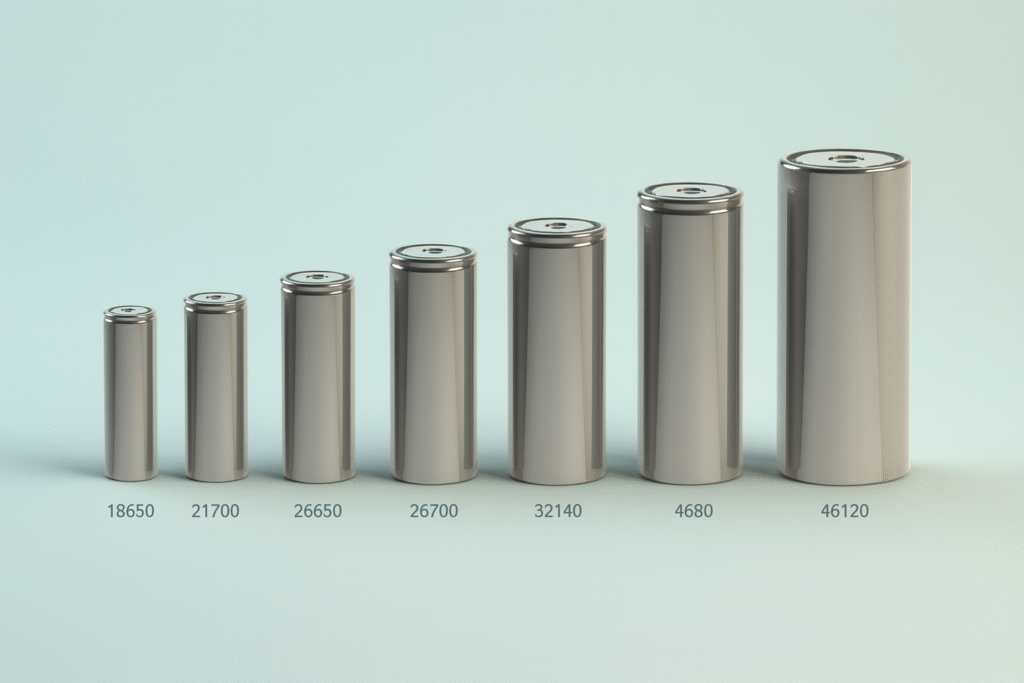
3. Major Cylindrical Cell Sizes and Use Cases
Below is an overview of common cylindrical cells, their dimensions, chemistry, and typical applications.
| Battery size | Diameter (mm) | Height (mm) | Capacity | Chemistry | Common applications |
| 10440 | 10 | 44 | <1000mAh | Ternary | Portable and compact consumer electronics like micro flashlights, mini speakers, e-cigarette, etc. |
| 14500 | 14 | 50 | <1000mAh | Ternary | LED flashlights, wireless speakers |
| 18650 | 18 | 65 | 1500~3500mAh | Ternary/LFP | Laptop, Portable Power Bank, e-bike, industrial tools, etc |
| 21700 | 21 | 70 | 4500-5000mAh | Ternary | EV, e-mobility devices, high-performance electric tools, etc. |
| 26650 | 26 | 65 | 3000~4000mAh(LFP) 3500~5500mAh(Ternary) | Ternary/LFP | Electric tools, e-bike, medical equipment, etc |
| 26700 | 26 | 70 | ~4000mAh | LFP (Mainstream) | E-mobility device, high-drain tools, industrial equipment, consumer electronics, etc |
| 32140 | 32 | 140 | ~15Ah | LFP | E-mobility device, high-drain tools, industrial equipment, consumer electronics, etc |
| 4680 | 46 | 80 | 15~16Ah(LFP) 20~24Ah(Ternary) | Ternary/LFP | EV |
| 4695 | 46 | 95 | ~30Ah | Ternary (mainstream) | EV |
| 46120 | 46 | 120 | ~25Ah | LFP(Mainstream) | EV |
3.1 18650: The Classic Standard
First introduced by Sony in 1991, the 18650 remains the most widely used cylindrical cell today.
It provides an excellent balance of size, performance, and cost.
Applications include:
Available in both NCM and LFP versions.
3.2 21700: More Power in a Similar Footprint
The 21700 cell increases both diameter and height compared to the 18650, enabling capacities around 4500–5000 mAh.
Tesla popularized this format, and many EV and tool manufacturers have since adopted it.
It remains the mainstream choice for high-performance EV models while 4680 production continues scaling.
3.3 26650: High-Power Performance
The 26650 (26mm × 65mm) offers higher capacity than the 18650 and supports high discharge rates.
Applications include:
Its larger size enhances performance but requires proper thermal management.
3.4 26700: LFP-Specific Evolution
The 26700 is an LFP-focused format, close to the 26650 in size but optimized for applications needing:
Common in mobility devices, industrial tools, and consumer equipment.
3.5 32140: Large-Format LFP Cell
A sizable LFP cell (32mm × 140mm), the 32140 is designed for:
Its large capacity provides long runtime and stable power delivery.
3.6 4680 / 4695 / 46120: The New Generation
First introduced by Tesla, the 4680 cell promises higher pack energy density and lower cost due to its large size and simplified pack design.
However, Tesla’s innovative dry-electrode process still faces mass-production challenges.
Meanwhile, Chinese manufacturers (CATL, EVE, BYD, Gotion) are promoting 4695 and 46120 variants using mature wet-process cathodes.
These cells began entering selected EV models in late 2024 and are expected to see broader adoption across premium EVs by 2026.
Part 2: Key Factors for Choosing the Right Battery Size
Selecting the right cylindrical battery involves more than just picking a form factor.
2.1 Application-Specific Requirements
Different applications require different characteristics:
Choosing the correct chemistry ensures the battery pack meets expectations for capacity, energy output, and longevity.
2.2 Compatibility With Devices and Systems
Batteries must match:
Choosing the wrong chemistry or size can lead to:
2.3 Balancing Energy Density, Size, and Cost
Every chemistry has trade-offs:
Understanding these trade-offs helps optimize battery pack design for your application.
2.4 Availability and Supply Chain Considerations
Material availability (especially cobalt and nickel) affects supply stability.
As the world moves toward a projected 1,200 GW of energy storage by 2030, robust supply chains and reliable manufacturing partners become critical.
Partnering with trusted suppliers ensures:
Final Thoughts
Cylindrical lithium-ion batteries come in many sizes and chemistries, each tailored for specific performance requirements. Whether you’re building an e-bike pack, designing an industrial tool, or evaluating EV cells, understanding the fundamentals—form factor, chemistry, performance, and supply chain—ensures you choose the right battery for your application.
 by
by